PODCAST | “Freedom to Learn:” Are West Virginia School Districts Canaries in a Coal Mine?
Tiffany Hoben on Financial, Academic, & Discipline Chaos in West Virginia Public Schools.
Tiffany Hoben, a former teacher and administrator, uncovered recurring and systemic failures in West Virginia’s school districts while combing through the state Board of Education’s special circumstance reviews of districts and schools. Her analysis revealed patterns of reckless hiring, catastrophic budget mismanagement, and unsafe classrooms.
Tiffany joined Freedom to Learn recently provide concrete and alarming examples of weak district leadership: staff with criminal records being hired, multimillion-dollar schemes defrauding districts, and classrooms left unsupervised. We discussed how districts are ignoring population declines and the end of temporary federal ESSER funding, digging themselves into deeper financial holes. Tiffany shared her insights about the hidden consequences of flawed policies that prevent teachers from maintaining order. And she highlighted the urgent need for accountability, smarter budgeting, aligned standards, and the expansion of education freedom opportunities like the state’s Hope Scholarship education savings account program.
Until recently, Tiffany was the Director of Education Partnerships and Strategy at the Cardinal Institute. In March, the Department of War (Defense) Education Activity announced that Tiffany will serve as Chief Academic Officer for DoWEA, the system that educates 67,000 military-connected children studying in 161 schools around the world.
Please follow or subscribe to Freedom to Learn on Spotify, Apple Podcasts, YouTube, or wherever you get your podcasts. New episodes are released every Thursday.
This conversation has been edited for length and clarity.
I’d like to start with your background before we dig into some recent research, a report that you’ve issued. You’re a former teacher. What drew you to teaching?
Tiffany Hoben: I went to college and got a bachelor’s in psychology. It turns out there’s not a lot you can do with that, and during that entire stint at college, I had been substitute teaching and grown to love it. You can be a teacher with a bachelor’s degree in psychology, so I went to work at the high school that I graduated from. It was in a community where I knew lots of people in the education world, and I just kept teaching.
I fell in love with middle schoolers, which is weird, because they’re weird. But I loved the middle school quirkiness. In the state of Florida, which is where I was teaching, civics became a middle school course early on in my career. I fell in love with teaching civics in government to middle school kids and early colonial U.S. history. I went to work at a district office, was a district administrator, and eventually worked at the Department of Education in Florida, working on the civics and government rollout under the DeSantis administration. And then from there, I came into the think tank world, and here we are.
Our paths did not cross at the Florida Department of Education. I found my time there extremely valuable to get that state perspective on what school districts are up to, because there are different ways to be a district administrator, and some get it right, and some don’t. There are different ways to be school board members, and some understand their responsibilities and some totally abdicate them. That’s what you dug into in the work that you have put together for the Cardinal Institute; you looked at the West Virginia Board of Education’s special circumstance reviews.
Tiffany Hoben: There were 10 school districts that were in the state takeover situation. And I just went and looked at those investigations. I didn’t conduct the investigations myself, I didn’t go ask anybody any questions, I just looked at the published reports on the DOE’s website, which were publicly available, and I made some policy recommendations around what I discovered.
With the special circumstances reviews, the state Board of Education either receives complaints or concerns from the community. Once they’ve determined that a special circumstances review is in order, the DOE has an investigative department. Those folks go out and conduct an investigation to see where the districts are either compliant or non-compliant based on whatever information that they were given. And so once that’s done, if it’s determined that the school district needs to be taken over by the state, they’ll issue directions in an executive brief, which also goes on their website saying what the next steps are for that school district.
I said, just in the last two years, if I took all of these, what would be the common themes? What are the threads? Is there something that’s going on everywhere, or some kind of pattern that I could find where we can offer some help and prevent other school districts from going down the same road?
I found three buckets of things that were common across all of these state takeovers. One was financial, either mismanagement, misconduct, fraud, some of it intentional, some of it not intentional. Academic issues and inconsistencies, and how standards and curriculum are applied. And discipline problems where discipline was totally mishandled, and students were in unsafe environments in a lot of cases. So those are the three big takeaways.
Give us some examples of what you were finding with the lack of financial discipline and the horrendous forecasting.
Tiffany Hoben: The primary problem was really ignoring the birth dearth. It was ignoring that enrollment is declining, and unfortunately, West Virginia is a state that had a problem with this anyway. Our population has been in decline for a very long time, out-migration has exceeded in-migration, maybe with the exception of the last two years.
To the points that you’ve made on other podcasts with other speakers, universities knew this was coming. Smart school districts knew this was coming. It’s a pretty simple graph to put together. How many incoming kids do we have? Can we continue to support this model? And do we need to look down the road and do three, four, five years worth of budgeting and figure out what this is going to look like? But when the funding formula is set up in such a way that it prioritizes buildings and staffing and transportation, you can ignore it.
And then ESSER was a big, huge bandaid that just plugged that hole for so long. They could just ignore the fact that the population was decreasing, that there weren’t as many students to serve, because there was this humongous influx of money that allowed them to be very flexible and spend however they wanted to.
Now that that’s gone, we’re seeing the cries of underfunding, the “sudden” $8 million deficit. There were several counties in this report with a $2 million deficit, or a $3 million deficit, and Hancock County had an $8 million deficit.
A lot of times, what they’re saying is, it’s special education funding. “Special education is bleeding us dry.” But at the same time, West Virginia has one of the highest identification rates in the country. So one might ask, instead of just putting more money into this program, into special education, just continuing to feed the beast, you might say, “How are you handling special education? Can we ask some questions about that? Why is our identification rate so high? Could that be attributed to something that people find is that money is not being used in the way that it’s intended? Or people think they can’t spend it on something that they can spend it on?”
One of the things that’s interesting to me is, ESSER funding was flagged for building repairs, [HV]AC maintenance. You could take care of mold. Anything to make the building safer, more efficient, any kind of updates that was allowable under ESSER. In many districts, they spent that money wisely and did those things. And in so many districts, they did not do those things. They hired more staff, and then the money goes away, and they can’t afford the staff anymore.
A building update that’s a one-time expense hopefully will prevent future expenses if you get ahead of maintenance issues. Hiring more staff or significantly increased staff salaries with temporary federal dollars, and that’s what you’re referring to when you say ESSER. These were temporary COVID-era federal dollars, and a lot of them: $190 billion nationwide. But if you use temporary dollars for a permanent cost, you’re digging yourself into a financial hole. And, as you’re saying, that was combined with a total disregard for our birth dearth, for the fact that people stopped having as many babies in 2008.
Tiffany Hoben: The federal government actually did a big investigation on one of the districts in West Virginia because they were using money to stay at resorts, go to restaurants, and these kinds of things. And that’s obviously fraud.
One of the things I bring up in the paper is how this is fraud — they knew what they were doing. Those buckets of money are earmarked for certain things. You worked at the Department of Education, can you buy food and or clothing with any dollars that come to you from a state or federal account? Absolutely not. That’s one thing in education that everybody knows. You cannot buy food and you cannot buy clothes. And these things are happening.
One school district was at a very low, less than 50%, seat capacity in their schools, and they started construction on a brand new school. It doesn’t take just one year to build a school, [so now] they’ve got recurring construction costs. Hancock County, the most recent county to get into trouble in West Virginia, had turf and lawn maintenance that was a $40,000 a month bill. I like football as much as the next person, and I think that it’s cool when a community rallies around their football team and they have the money to do that kind of thing. But if you’re in dire straits and you’re thinking, “Do we spend money effectively and efficiently on curriculum to try and increase the academic performance of our kids? Or do we sign up recurring ongoing contracts for lawn maintenance that’s going to cost an exorbitant amount of money?” Sometimes when you’re budgeting, you have to make hard decisions. And every once in a while, you have to cut things that you don’t want to cut. Sometimes you have to let people go. These are the problems that are faced and it takes strong leadership to do that. We did not see that happen here.
One of the things that stood out to me in the report is that a school board member said he would never vote to close the elementary school because it was a campaign promise. Well, that was a campaign promise that you made foolishly because the building was operating at 22% capacity. So, sometimes you’re going to have to make those tough decisions and tough votes even though you’re going to be unpopular, because it’s financially foolish at 22% capacity to keep a school open. You can’t justify that if you’re talking about the dire straits that you’re mentioning. And for our DC listeners, an $8 million deficit might not sound like that much money because we operate in billions and trillions in DC. It’s a lot of money to a West Virginia school district.
Tiffany Hoben: It is. There’s a reason why a board is a board, and it’s more than one person. One person doesn’t have to bear the entire responsibility of making those hard decisions, and the board has the financial responsibility. They hold the purse strings.
I think the School Boards for Academic Excellence does a really good job of explaining this. You hold the purse strings. You’re supposed to be making the decisions about what the policy is and what happens. And then the superintendent executes those things. And the reason there’s more than one person on the board is so that no one bears the total 100 percent responsibility for being the adults in the room.
I think most school districts across the country are dealing with things that are similar to this because the ESSER cliff is happening for everybody. Discipline is this thing that’s like bubbling all the time. We’re talking about NAEP scores all the time. We have a reading crisis, and we have a math crisis. So I think that everybody understands on some level, the symptoms are all different in different places, but on some level, most public schools are dealing with all three of these issues: finances, academics, discipline.
I think the symptoms are manifesting quicker and more aggressively in West Virginia than they are in other states, but it’s coming. That’s my crystal ball prediction for the day, is that I think West Virginia, no pun intended, could be seen as a canary in a coal mine for what’s coming for some of these other districts if they don’t play their cards right post-ESSER.
Marguerite Rosa from the Edunomics Lab at Georgetown was one of our first guests when we launched the Freedom to Learn podcast in order to say it’s coming. But I think we are going to need to present these specific examples for people to believe us and to start taking responsibility and accountability.
Before we move on from the financial category, the report mentioned a former maintenance director indicted for orchestrating a $3.4 million kickback scheme who defrauded the district through manipulated federal contracts. And I mentioned that because, again, $3.4 million in West Virginia is a lot. And let’s not ignore that fraud is happening. Don’t pretend that it’s not.
Let’s talk about the chaotic classrooms. You highlighted an example from the reviews where there was no teacher in the classroom. These were on days when the investigators were coming, so everybody was probably on their best behavior; but they’d walk into a classroom and there wouldn’t be a teacher there. Were there other examples that stood out to you?
Tiffany Hoben: The two middle schools in the review were the ones that housed the most discipline problems, and discipline applied inconsistently. There are some level four offenses — something that would require the law, aggressive behavior like a fist fight, bringing a weapon to school, having drugs at school — it’s something that’s very serious because it requires expulsion. So there’s some lines you’ve got to cross to be expelled from school. And typically, they would involve at least a resource officer. What we saw was level four violations of discipline code, but no expulsions to match it, or not enough expulsions to match it. To avoid disciplinary problems that were happening in places like bathrooms, bathrooms were locked.
And to your point, the investigation crew showed up at a school and went into a classroom to do a random check and there was no adult in the room. And they buzzed the office to see where the teacher is, and she’s down in the office dropping things off. As a percentage of the population, how many people have been inside of a middle school classroom since they were in middle school? I’m just going to tell you right now, of all the kids to leave in a classroom by themselves, middle school is not the one to do it with.
So, my questions become things like, “What if you’re the parent of one of the other kids in that class? Did you ever find out that the teacher left the room? Do you care that the teacher left the room?” I care. I know middle schoolers really, really well. I don’t want, especially my daughter, a middle schooler, to be left alone in a classroom without an adult present. I want my child to have access to the bathroom all the time. I want discipline applied consistently so that my child can go to school and feel safe.
I think a lot of times we make this about the student, we have for many, many years made this about the student receiving the discipline. We have to be fair to them. We have to not have bias or racist practices or whatever against the student who’s committed whatever the disciplinary infraction is. And we’ve done that to the detriment of everyone else in the classroom. We are not bothering to let parents know that there are students that are constant disruptions to their students’ learning.
I think if parents had a line of sight, clear line of sight into what their kids deal with in schools, especially middle schools in this country every single day, they would not be happy about it. If you or I, based on our age and our middle school experience, saw what happens in a middle school, we would be outraged. But a kid that started in kindergarten and then made their way now to sixth or seventh grade doesn’t see anything unusual and doesn’t feel any reason to go home and report to their parents that things are crazy in their classroom, because it’s always been that way. To them, that’s nothing new.
I wonder if one of the contributing factors was something that you identified, chronic teacher absenteeism. We talk about chronic student absenteeism a lot since the COVID era because it doubled and is staying alarmingly high. But chronic teacher absenteeism leads to chaos in the classroom if you’re talking substitutes on a regular basis or long-term substitutes. That perhaps is a podcast topic for another day, but I appreciated you flagging that as one of the issues. We need to talk about that.
Tiffany Hoben: That signals something to the kids about the seriousness of not being there. I think that there’s just a lack of seriousness, both in our truancy issues and our teacher absentee issues.
Can we talk about some reckless hiring practices that were identified? A sex offender who put it on the job application, but was still hired. How is that happening?
Tiffany Hoben: This was one of the really scary things. At one of the school districts in West Virginia, an individual was hired to be a maintenance staff worker who had something on their record. The superintendent was related to this person, so they knew that the report was going to come back with something on it, and they all just put their heads down and hired this person anyway. In fact, the person was working on campus before the paperwork was complete, before the hiring package was completely done.
In other school districts, you have things like teacher transfer. One teacher comes from a different district and moves into this new district and they don’t do a background check. People were being hired that weren’t credentialed. In some cases, the teachers didn’t even hold a bachelor’s degree. They were being hired for a teaching position. That’s pretty standard practice in all 50 states; to get a teaching license, you have to at least have a bachelor’s degree in something. So, we just saw this really inconsistent hiring pattern.
There was very little consideration given to looking into people’s backgrounds, to finding out the reasons why they might be switching from one district to another in the middle of the school year or over the summer. These are the things that invite bad actors into our school districts. These things are really dangerous and they’re just asking for people to be in our schools that we don’t want with our kids.
You put a helpful feature into the report, which indicates what the graduation rate is in the school districts, and what the proficiency rates are. Overall, West Virginia has significant challenges when it comes to proficiency rates. That mismatch is quite startling, though. Was that your intention to show the misalignment there?
Tiffany Hoben: Yes, and that is not unique to West Virginia. It’s just pieces of information that haven’t historically been put next to each other. I want people to look at these numbers and say, “Why is this so different? How can we be graduating 97% of our students, but only 30% of them are reading or writing at grade level, or doing math at grade level?”
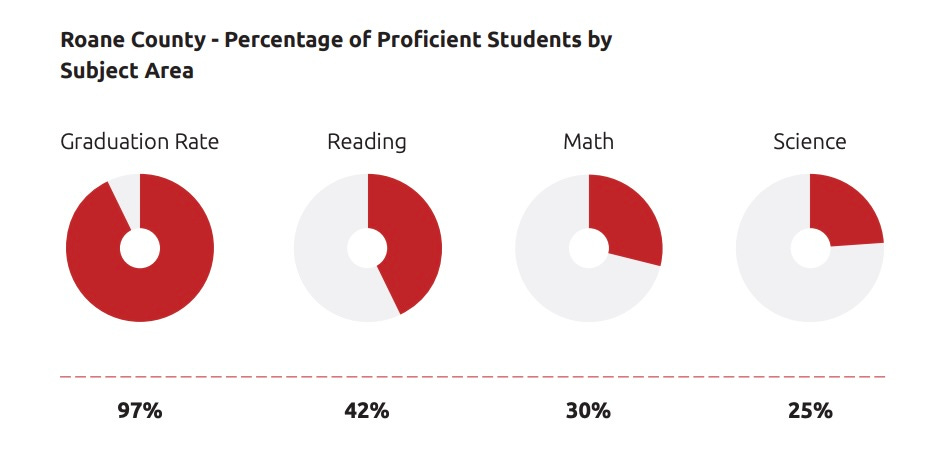
When NAEP comes out, people want to split hairs over whether NAEP is a good assessment, what does proficient mean? What is, right? All of these terms and definitions. It doesn’t matter what tests you consult, the state reported data, the NAEP data, does it really matter if it’s 30% or 36%? At the end of the day, what we’re talking about is for every 10 kids attending school, three or four of them are operating at grade level, starting from third grade, fourth grade. So you’re telling me by the time they get to 12th, they’ve not lost more ground? Are you going to try and make an argument that they’ve gained all that ground in all that time? You can look at the 11th and 12th grade scores and see they haven’t gained any ground, and yet we’re sending them out the door with diplomas.
I think that from a national perspective, what that means is, our colleges are saying, “these kids are not ready for college.” Our workforce is saying, “Actually, these kids are not even really ready to be in the workforce.” We’ve got kids suing their school districts because they graduated and they can’t read. This is a real problem. And so you have to ask: What is the disconnect there? Who is in control of those levers? And who’s in control of the graduation lever? Everyone at the school. Those are the only people that control the graduation rate. They decide the grades, they decide on grade promotions, they decide who walks out the door and who doesn’t.
We have to start asking: What is the incentive alignment on graduation versus what’s the incentive alignment on these test scores? Who’s telling the truth and who’s not, and what are we going to do about it?
There are things that can be done. Could you give us a sampling of some of your recommendations?
Tiffany Hoben: I think it’s all common sense. The main thing in finance is to acknowledge that ESSER is over and adjust your budgets accordingly. I think that if a school district is in receivership, it might be an opportunity to consolidate that district into another district and take advantage of getting rid of some of those higher level staff, especially in a state like West Virginia, where all of our school districts are relatively small anyway. The boards have got to wake up and start asking questions about where the money goes and what the return on the investment is for the money that they spend. It can’t just be blindly putting money into staffing, and the disconnect between hiring teachers and hiring additional administrative staff and staff that’s on school sites, but they’re not load-bearing staff. They’re not people who actually have kids in a classroom all day. Those are the kinds of questions we need to be asking, too: “Is this really doing what we said it’s going to do? We originally said, let’s hire all these people to do X.” Did you accomplish that? And if you didn’t, it’s time to cut some of those folks loose.
On the academic side, I think this is probably a whole other podcast, too, but there’s a lot of scatter shot curriculum and instruction stuff going on across all these districts and there’s not a lot of alignment. Some people might say, well, it sounds like you’re arguing for a Common Core situation. You want to take away teacher autonomy. I don’t want to do any of that. For the sake of transparency and for the sake of parents understanding what’s happening inside classrooms, I just want the state to align on what it wants to teach and to teach strong content-based, vertically aligned standards, and get a good curriculum. States have done this, Mississippi, Louisiana. There’s all kinds of states that have modeled this really well, that align vertically from year to year, and get everybody moving in the same direction.
There’s something in between strictly mandated scripted lessons, and everybody does whatever they want to do. So, I think we can find a sweet spot there.
On the discipline front, we passed a bill here to help, because we had elementary school teachers coming into the legislature with bruises on their bodies, testifying and saying, “These kids are throwing chairs. This is a real problem. We need help with discipline in elementary school.” So they passed this bill and then the DOE wrote the policy, and the policy still contains all this language about trauma-informed care and counseling sessions, pulling the kid out of the classroom [means] the teacher has to do weeks of documentation. The other students in that class can’t afford weeks and weeks of deterrence while that student takes up 70-80% of that teacher’s bandwidth and capacity to instruct the class to keep things managed and in order.
That was why I left teaching in the end, because I had two students in one class that took up 80% of my bandwidth every single day. I couldn’t believe it. And there were these other kids in the classroom and I could see in their eyes that they were starving. They wanted to engage with me. They wanted to read the books. And I was constantly pulled away dealing with discipline issues. And what I should have been able to do was send that student out and have the administration say to the parents, “Your child has a right to be here, but they do not have a right to infringe on the education of every other student in this school.”
I know that the Obama-era Dear Colleague Letter was intended to right wrongs. I don’t denounce that in terms of, if you’re abusing your power, that should be checked. But I think that can be checked locally. I think teachers are generally good actors who are trying to keep some sort of semblance in their classroom. They don’t want chaos. That instruction to states on how to handle discipline took all the power away from the teacher, took all the power away from the school, turned it into a compliance issue. And the people who suffered from that the most were the kids that came to school every day to learn.
Tiffany, we would be remiss in not acknowledging that West Virginia has a HOPE Scholarship Program that will be truly universal in the upcoming school year.
Tiffany Hoben: HOPE is universal now. We passed our legislative mark. The 45-day rule drops away next school year, which is great because it means it’s accessible to every single child in West Virginia, whether they’ve ever attended a public school or not.
I wrote this paper because I think that our public school system has been in the past and can be again a force for good. It is a public good when it’s done well. There are lots of kids there, and those kids deserve a good education. They deserve to spend time with a teacher every day that cares about them and wants to share his or her knowledge with them. So I think it’s worth reform. I think it’s worth thinking about what we need to do to make public schools better.
But I also think that free markets work, and a little competition is healthy. Our ESA program is for parents who are fed up and can’t wait for the system to write standards, implement curriculum, create buy-in and retrain everybody. We should still try to figure it out, but for families that don’t want to wait, accessing our ESA program means they get to immediately start remediating. They get to immediately start creating the kind of environment where their kids are going to flourish and thrive and be happy and healthy and productive members of our society, and stay in our state, which is ultimately what we would like for them to do.
I think pitting public schools versus ESAs, vouchers, private, and charters is the wrong approach. We want every kid to have access to any and every program that’s gonna allow them to thrive and be successful. The public school union-driven message that “vouchers” are defunding public schools and robbing funding from them is obviously nonsense, because we’ve documented all the ways in which they’ve done this to themselves. And we have to stop that nonsense. We’re all on the same team, and we want a really good education for kids. I think that’s the attitude that we have to have going forward.
I typically ask my guests to wrap us up with an education freedom myth that bothers them the most that they’d like to dispel. You just tackled “vouchers defund the public school.” Is there anything else that you’d want to tackle today?
Tiffany Hoben: For lawmakers and people who think about policy, we tend to get siloed in our favorite area. But finances, academics, and discipline are all a braid. And when you braid something together, every strand has to be strong and aligned in order for the braid to do what it’s supposed to do. I think that those three things go together, and there’s a danger in only thinking about finances, or only thinking about discipline, because all of those things drive each other and hold a school together, and they should be thought about as one piece altogether.
Related
OP-ED: Why Sean Duffy’s Fight To Fix The Frightening Reality Of School Bus Safety Is Being Blocked