PODCAST | “Freedom to Learn:” Federal Education at a Crossroads (Again)
Christy Wolfe on Federal Education Silos, Bipartisanship, & State Constraints.
Is a bipartisan approach to addressing federal education policy woes possible? Last week, Christy Wolfe of the Bipartisan Policy Center (BPC) joined Freedom to Learn to discuss why federal programs remain stubbornly siloed, why Congress hasn’t reauthorized major education laws, and whether the Department of Education is truly a “pass-through” agency. Christy shared resources she has created that explain federal formula funding (e.g., Title I and the Individuals with Disabilities Education Act), competitive grants, and block grants. Recent BPC reports include:
U.S. Department of Education 101: Federal Funding in K-12 Education
U.S. Department of Education 101: What are Block Grants?
During our conversation, Christy shared her views on what interagency agreements (IAAs) mean in practice and we identified barriers to state flexibility, including compliance fears, waiver fatigue, talent constraints, and state accounting restrictions. We also reminisced about the 1998 Education at a Crossroads: What Works and What’s Wasted in Education Today congressonal report, which enumerated the federal bureaucratic burden imposed on states.
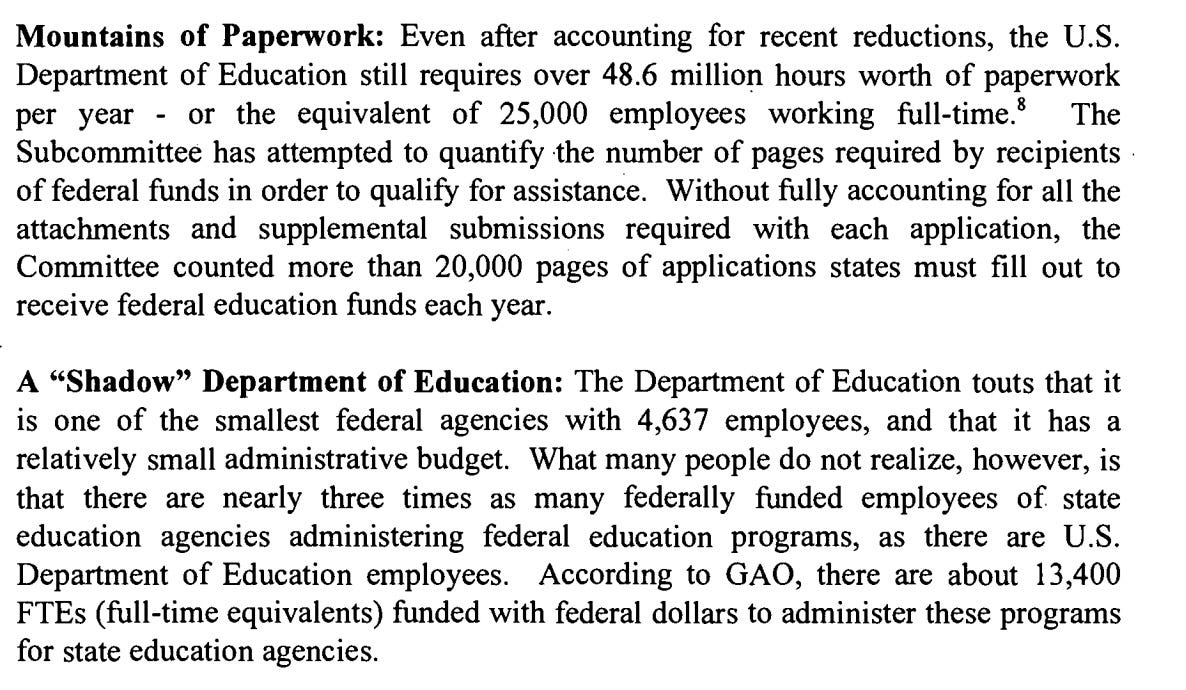
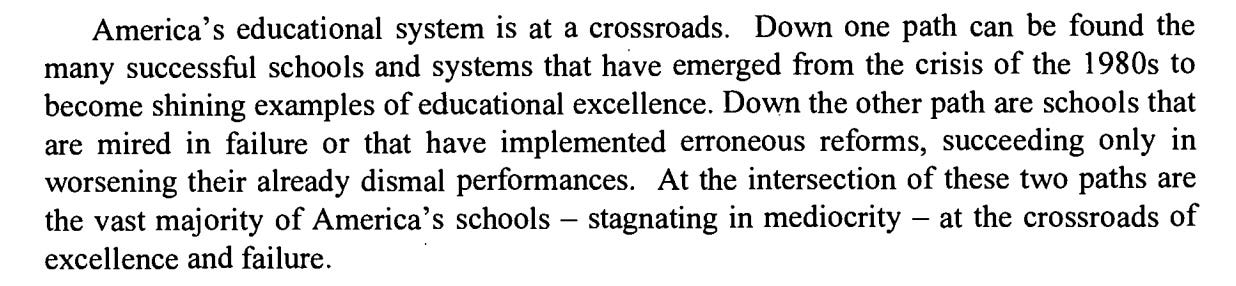
That was almost 30 years ago — just imagine the bureaucratic burden states face today! Now that the nation is once again acknowledging that the nation’s educational system is “at the crossroads of excellence and failure,” I think it’s time to reign in the sprawling, siloed federal education programs and empower states, communities, and families to focus resources on meeting the urgent needs of students. Listen to our Freedom to Learn conversation to hear Christy’s thoughts.
Please follow or subscribe to Freedom to Learn on Spotify, Apple Podcasts, YouTube, or wherever you get your podcasts. New episodes are released every Thursday.
This conversation has been edited for length and clarity.
You work at the Bipartisan Policy Center. Bipartisan isn’t a word we hear around Washington too much these days. What’s the mission of the organization?
Christy Wolfe: The Bipartisan Policy Center was formed about 20 years ago with a bipartisan cohort from Congress, Senator Dole and Daschle in particular, wanting to show folks that it’s possible to get things done in Congress, even if you have differing views across a wide spectrum. It doesn’t require you to give up those views. It requires you to really just get to the heart of the problems that you’re trying to solve.
BPC has been getting some attention for a recent report from the Commission on the American Workforce. It’s a blueprint for a national strategy to connect people to opportunity.
Christy Wolfe: The name of the report is From a Nation at Risk to a Nation at Work. It really seeks to holistically look at, from a federal perspective and the federal role, how can we have better coordinated efforts in the childcare space, pre-K, K-12, post-secondary, higher education, and into the workforce, to really address the problems that are facing our nation today? AI in the workforce, the challenges of education and educational outcomes, and the declines that we’re seeing, especially for the lowest performing kids. How can you look at that in a holistic way?
Because of the way Congress has addressed the statutes, they’re all very siloed. You have the Higher Education Act, the Elementary and Secondary Education Act, and a different committee addressing some other issues. So this report really tries to tie all the threads together. How can you have executive leadership with the National Talent Council, look at the data holistically, the research holistically, and make sure that Americans can flourish in the workforce and as human beings?
We’ve talked in a recent episode about IDEA, the Individuals with Disabilities Education Act, not being reauthorized for over 20 years. The top of the webpage that hosts this report points out that a lot of these federal laws haven’t been reauthorized for a really long time. Why is that? Is Congress afraid to tackle these issues? Are other issues just drawing their attention elsewhere?
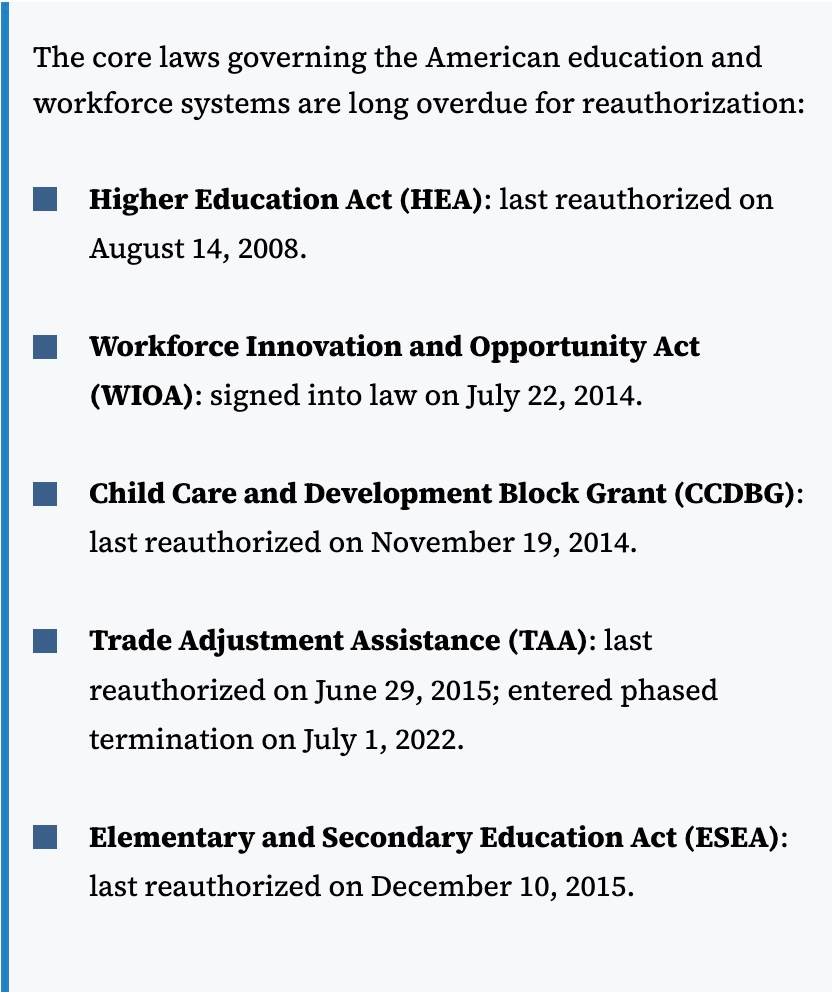
Christy Wolfe: I think that it’s a combination of a lot of things. It seems like we’ve gotten to a point where Congress acts when it has to, to mitigate catastrophe or to keep laws in place that are required to keep funding. You have NDAA, the National Defense Authorization Act, the Farm Bill, although even that has become less of a must-pass bill, and then the appropriations bills.
To get to a point where you can convince members of Congress that there’s a significant sense of urgency, that it’s worthwhile to spend the political capital to get things done, just has not been the case.
And then you have folks that are just afraid of reopening it — the cost benefit, will we get a better law if we push to get the law reopened? And I think that’s certainly the case with the Individual Disabilities Education Act. There has not been a consensus that this is a great time to revisit everything.
You’ve issued a series of highly digestible reports explaining key components of federal K-12 education policy. Who is your audience? Is it the congressional staff? Is it broader than that?
Christy Wolfe: It’s congressional staff and broader. BPC is entering into the conversation to try to bring more bipartisanship. There’s a lot of information out there where people can get older or very dense information about how these programs work. But what I’m trying to do is to provide for someone who knows nothing and just wants to start getting to understand these programs. Is that primarily congressional staff? Yes, but also, with this cross-cutting work that we’re trying to do, we want to break down some of the silos.
There are some labor staff at committees or folks in outside organizations that primarily focus on the workforce. Maybe it’s time for them to start learning a little bit more about how these education programs work. For folks at the state level, it’s surprising to me how narrow folks’ aperture can be, even within state and local educational agencies. They work with a particular program, and that’s it.
When you say that there are dense resources out there, I think of the Congressional Research Service, or CRS. The brilliant staff just do an incredible job creating very detailed reports. I appreciate that you’ve created something that complements the CRS reports.
Christy Wolfe: I think it makes a difference, too, if you’ve had to do the work of developing the policy and implementing the policy and then looking back on how to you explain how all this works now. I think that it’s a different lens than CRS.
Let’s talk about the major K-12 federal programs that fall under the U.S. Department of Education’s umbrella. There are the big formula programs: Title I, IDEA. There are the small competitive grants, including the Charter Schools Program, and you are the nation’s expert on CSP. And we say small, but that’s up to $500 million now.
You pointed out in this report that 90% of federal K-12 spending is allocated via formula grants. So, as much as the competitions and the competitive grants take up staff time and get attention in the media nationwide, it’s really these formula grants that are driving K-12 funding and policy from a federal level.
Christy Wolfe: That’s right. I think that they have some of the longest histories, too, in the federal statutes in terms of the original purpose, Title I being in the original Elementary and Secondary Education Act, the Charter Schools Program coming along much later.
Where there’s broad agreement on what a law is going to do, you’re able to put a lot more resources behind that. Some may say that Title I probably goes to too many districts. It has several formulas in it that are designed to target different types of poverty and concentrations of poverty. The poverty data drives the allocation of the funds, but any kid can benefit from it, whether or not they’re poor. There’s a lot of agreement and flexibility in that program. IDEA is a very different animal with a large number of resources, as well. There’s no one size that fits all for types of programs. You can agree on what 90% of the districts or most districts will need and the support that they’re getting from the government. And then you have these other more boutique competitive grant programs that serve distinct purposes that not everyone’s going to apply for, not everyone’s going to get, nor should they. They’re serving different purposes.
When we’re talking small versus large, competitive versus formula, I mentioned the Charter Schools Program receives $500 million. That’s a big one when it comes to a competitive grant program. When we’re talking Title I formula grant, $18 billion. IDEA, smaller than that, but of that scale. So billions versus millions, and as you said, they’ve been in existence for a long time. Title I since 1965. Long before the creation of the U.S. Department of Education, which came into being in 1980. IDEA was passed (with a different name) in 1975. Again, before the creation of the U.S. Department of Education.
They’ve been described by Secretary McMahon as funding that passes through the department. She describes the U.S. Department of Education as a “pass-through” agency, meaning Congress appropriates these funds and has for many decades, and then the department passes them along to states, again, mostly by formula, that are established by law.
Would you agree with that characterization of the department as a pass-through agency? How would you describe the department’s role in this process of allocating these funds?
Christy Wolfe: I would not generalize the role of the Department of Ed as a pass-through agency. I think if it were, there would be things that were less complicated than we’re talking about right now. In a perfect world, the Department of Education is adding significant value to the dollars in addition to how Congress has directed the flow of those dollars through formula.
With IDEA, there are more people who experience the law itself and its directives down to the local level. The federal requirements go down in a lot more detail down to the local level to protect kids and their right to a free and appropriate education. Because of that, there’s a lot of technical assistance and resources that come alongside that to ensure compliance. When you have a private right of action to sue because you’re not getting FAPE, that triggers a lot of resources. So I think it would be inaccurate to call IDEA a pass-through program for those reasons.
I think on Title I, there’s a significant component of it that’s about getting resources where there aren’t enough resources because of statewide poverty — statewide formula allocations, how districts choose to fund lower-poverty and higher-poverty schools. There’s a focus in thinking about where the money needs to go to help the neediest kids. Over the years, an accountability requirement has been laid on top of that as people have realized that maybe just sending money through formulas is not quite enough. There needs to be some more reporting and accountability on top of that.
Then, you have state educational agencies. They’re not staffed to necessarily be creative, and this is not disparaging of any of them. There are different capacities depending on how they’ve chosen to staff those agencies. But they may rely on folks at the department to a great degree to understand what are the best ways, what are other states doing? So, there is value that is added as states develop their assessments, as they develop their accountability systems. They’re really looking at the department.
Does the department do it perfectly? No. Does it do it perfectly in the context of smaller competitive grant programs? No. But your question was whether or not they are pass-throughs, and I would say no.
I hear you saying no, and I hear you saying there are these layers of accountability. I would maybe characterize it more as layers of compliance.
You mentioned that the states are looking to the department for best practices. You didn’t use that term, but the idea of, what are other states doing? I would say that’s because the states are afraid of getting in trouble from the department. So it’s not necessarily this inherent desire to do better, it’s a desire to not be punished for what they are doing. So they’re seeking permission, they’re seeking protection from this compliance regime. So maybe I would characterize it differently. Part of that is from working at the Florida Department of Education years ago. I’ve done both, the U.S. Department of Education and the Florida Department of Education, and there’s a lot of fear at the state level that you’re going to get in trouble.
Christy Wolfe: On the IDEA side of things, where you’re dealing with a different requirement and a baseline from the federal government for FAPE, that is one of the big struggles of IDEA. How do you focus on real outcomes and not box-checking? Because that’s the easiest thing to do.
I think states want to know: What did you say some other state did? Can we do that? Because it’s not just a fear, but it’s also in this context of waivers right now. Indiana is doing a lot of hard work thinking about, under the current requirements of federal law, what are some creative things we can do? Are other states doing that? Or are they just waiting for Indiana and then copy-paste?
This gets to the issue of how the agencies are staffed. If you’re staffing with compliance-focused grants management people, that’s the perspective they bring to the program. If you staff with folks who are looking at broader objectives and outcomes and are looking at how we use the tools that we have to get there, you’re in a very different place. Over the years that I’ve worked in the space of trying to get flexibility to the states, this is what I’ve seen time and time again, that if you have overworked, understaffed, SEA offices, the last thing they want to hear is, “Would you like to apply for a waiver demo under a state flex or some kind of flexibility authority?,” which we had for a number of years.
You’re talking about the need for investment in talent and then also a shift in mindset. That’s different from what I talk about a lot on the podcast, which is “process” things like the department encouraging waiver applications. You’re saying that’s nice, but you have to have these other things happen at the state level for the states to really embrace that and run with that. I would say that if states have applied enough for predecessors to waivers, for flexibility, for alternative assessments, there’s also this defeatist mentality of, “We have limited time and resources, and it’s a gamble, and I’m not going to invest in this thing that maybe is not going to pan out.” There’s that risk-aversion based on past experience that might happen, too.
I’m curious about your perspective on the interagency agreements. At this point, the Department of Education has announced 10, with five different federal agencies: Labor, State, HHS, Interior, and the most recent one was the Treasury Department. I’d love to hear your interpretation of what an IAA is, and your thoughts on this approach.
Christy Wolfe: I have written a paper on some of the initial questions about how these IAAs will work. The interagency agreement mechanism has been used in the past on a much smaller scale to provide a framework outside of Congress for agencies to work together on a project as co-equals. Not “Will you do my dirty work for me?” Or, “This is not something we want to do.” “This is something that we’re going to work on together, a joint project” is what IAAs are. They’re being used at a scale and for a purpose that has not been tested before.
I think one of the questions that I’ve been trying to understand is what problems are being solved by the IAAs. Doing the math, having a state deal with two separate agency roles for a single program doesn’t “math” well in terms of streamlining and getting programs out of the way that aren’t working and things back to the states.
Why would they have to interact with two agencies? If the IAA is saying, “Hey, these particular programs are moving over to Labor or to Health and Human Services, and the staff is going with them, we’re detailing the Department of Education grants management staff,” why would a state have to interact with two agencies?
Christy Wolfe: That’s a good question. It depends on what suite of programs they are working with and to what degree they’re elevating and having to deal with policy challenges. So, it’s a little hard to know right now because the changes haven’t taken place, particularly in the K-12 environment. They have in the labor environment. So, everyone’s still talking to folks at the Department of Ed. There’s always a point where you have a funding issue, which, it’s my understanding, is that the grant allocations would be coming out of Labor. And there’s always some kind of policy issue, which, in my understanding, is staying at the Department of Ed.
The thing that hasn’t really been talked about a lot is the grant management structures themselves, like G5, which was designed for Department of Ed programming. You can’t just plop that over to Labor. I think that one of the initial issues that they were running into at Labor was having to use their grant management system, which isn’t designed for the types of programs that moved over there. It’s hard to articulate if you haven’t been on the other side of having to manage a G5 grant and work with the program officers on the policy side. It’s all very connected.
You expressed a concern that all this might slow down funding and increase timelines for states to get answers. We don’t have evidence of that because it hasn’t rolled out, except if you’re talking about workforce.
Christy Wolfe: They’ve moved over, yes, but there have been a lot of bumps on the road on the state side in terms of figuring out the nuts and bolts again of these grants management entities that you need to draw down your funds and demonstrate that you’ve submitted your performance reports. You don’t automatically get your next year of funding. There has to be a policy person who’s deciding whether or not you’ve met your performance targets that you put in your grant if it’s a competitive grant.
So yes, I think that there could be a division of labor, in theory. When there’s disagreement, each agency is equal. There’s sort of an assumption that there won’t be disagreement or disputes that have to get resolved. But you could imagine someone having equally valid opinions on either side. That happens all the time within an agency. How is that all getting worked out?
This is all kind of not kind of missing the larger point, though, that there’s a lot of energy that’s being directed towards this process that’s potentially further siloing programs that we’re talking about. How do we get these things to work together? And in a way that’s not a pendulum swinging back and forth all the time. These aren’t codified. They could change again. If it’s this way this year, what will it be like next year? How do you get to the point that Congress is the one that prevents the pendulum from swinging and actually causes the coordination? Things aren’t magically coordinated just because all of sudden they’re in the Department of Labor, those programs themselves have to talk to each other.
You’ve written that Congress created the Department of Education, and it can only be dissolved through legislative action and a change in the statute. When we’re talking about these IAAs with multiple federal agencies, that is what the administration officials are calling a “proof of concept.” They’re trying to show Congress that the Department of Education can be dissolved. And they have been very clear that they agree with you, it can only be dissolved through legislative action and a change in the statute. Do you see any interest or momentum in Congress to take action on this front? Have you seen that in years past?
Christy Wolfe: No. Yes, I would say in the mid-90s, closer to the creation of the department that was seen as, let’s try to undo something that’s a relatively new agency. In the mid-90s, there was a Contract with America proposal to get rid of 10 cabinet agencies, not just the Department of Education. The Department of Ed was one of those, and there were several bills in Congress to get rid of them.
Even my time in the U.S. House Education and Workforce Committee working on the Education at a Crossroads project, that was about making it work better, not getting rid of it. Because again, what problem are we solving? What is not working well? What is the best way to make the solution?
If your problem is just the mere existence of an agency, and not the educational problems that kids are facing, then maybe that is a proof of concept that it doesn’t have to technically exist for the programs to get the money out the door. But again, what is the larger problem that we’re trying to solve, and what is the best way to ensure that kids and parents are getting transparent information and value out of the tax dollars that are going to Washington to fund these programs?
Let’s just pause for a moment of nostalgia for the 1998 Education at a Crossroads report. You and I were both working on Capitol Hill at the time. It identified over 760 federal education programs spread across 39 agencies. The idea was to figure out what’s working, what’s wasted, and what should be done. And it doesn’t seem like we found a solution to that. It was a helpful conversation to have in the 90s. And then federal education policy went a different direction, especially with No Child Left Behind. And it seems like now we’re opening that conversation again. But I think what you’re saying is, let’s not get caught up in the mechanics of dismantling without a bigger picture goal of what we’re trying to do.
What are the big picture recommendations that you have? If not IAAs, if not waivers, then what should the department be thinking about? Or what should the administration, what should Congress be thinking about?
Christy Wolfe: Let’s find the sticking points, and then we’re going to need to go to Congress to address those sticking points, not move a program somewhere else.
One of the sticking points is where states want to fund within the state. Most of the waivers that are coming in are not authorized under law and there are a lot of states’ hands being tied when it comes to decisions about where to send the money in the states. There have been efforts in the past to try to get on the table, can a state at least request a waiver to change how funds go within a state for different purposes? Can they have more flexibility about how they use their state set-aside and the funds themselves?
Why can’t we come to an agreement, and put on an appropriations bill that you can reallocate funds within the state for certain purposes, as long as they’re not decreasing funds for high poverty. Whatever safeguards you wanted, but maybe we can open that door. Then, all of a sudden, you’re having a different conversation for the types of waivers states can have.
That’s a hard process that requires real listening and translating, because sometimes what people are feeling and experiencing at the state and local level is not because of federal requirements, but because of state layers that they put on top of it.
Another example: the Title I school-wide program authority, which allows schools to consolidate all of their federal funds and use them for any purpose under ESEA. It was the most flexible block grant that you can think of — you’re just serving the kids. You’re potentially relieved from a lot of the individual tracking. There’s one state that has really been able to push that consolidation implementation down to the local level. This has been an authority that’s been in place for 30 years because of state accounting rules that get in the way, and that takes a lot of work to break that down.
Interesting. So who should go about taking a look at those state obstacles?
Christy Wolfe: Louisiana is an example of the state level, at least, not necessarily down at the school-wide consolidation level. Districts have not been required to submit a bunch of different applications for all these federal programs. They’ve been able to have a consolidated application, but they haven’t been able to map their federal resources to their local purposes without looking at the lines of the programs themselves. So this is something called SuperApp [from Watershed Advisors].
It would be great if the department was doing more to support that intentionally through technical assistance, or even if it was prioritized and not implied that they’re just ready and waiting to do the thing as soon as they get the ability to request a waiver.
It’s a great opportunity for organizations like the Council of Chief State School Officers or other information sharing organizations like Education Commission of the States to really look for those. They’re kind of boring examples of how you have to get rid of those statewide accounting codes. But they’re important, so you have to have folks willing to roll up their sleeves and do the drudge work.
I’m so glad that you mentioned this as something that needs more attention. This sounds like bipartisan policy.
Christy Wolfe: We need a national summit on how to consolidate school-wide funds.
Sounds so fun, Christy!
Christy Wolfe: There used to be more of an emphasis on that kind of work. Take advantage of the opportunities that you have to direct resources to things that really have an impact.
How can people follow your work?
Christy Wolfe: We have a K-12 section of the BPC website. We also have something called BPC U, which is a great place to interact with 101 explainers on a bunch of different issues. I do try to stay active on LinkedIn to provide a preview of some of the work that I’m writing.