PODCAST | “Freedom to Learn:” “Get In, Loser. We’re Unionizing the Researchers.”
Jay Greene on Radical Graduate Student Unions, Teachers Unions, & Foreign Influence on Higher Education.
Graduate student unions are morphing into political tools for foreign political agendas and radical ideologies, according to a new report, “The Radicalism of Graduate Student Unions Affiliated with the Teacher Unions.” DFI senior fellow Jay Greene joined the podcast to discuss his research exposing how American Federation of Teachers-sponsored graduate labor unions are obsessed with anti-American, anti-Israel, and pro-communist activism and how higher education visa practices are fueling this trend. Jay proposes a few practical solutions, including imposing visa limits, requiring affidavits against foreign affiliations, and conditioning federal funding to curb foreign-backed activism.
Please follow or subscribe to Freedom to Learn on Spotify, Apple Podcasts, YouTube, or wherever you get your podcasts. New episodes are released every Thursday.
This conversation has been edited for length and clarity.
Your new report, “The Radicalism of Graduate Student Unions Affiliated with the Teacher Unions,” analyzes graduate student organizations.
Jay Greene: They’re graduate labor organizations (GLOs). These are unions. They’re not simply clubs. A lot of universities have clubs for graduate students to be part of. This is an actual labor union with collective bargaining rights and so on.
So these are graduate student unions primarily organized by the American Federation of Teachers.
Jay Greene: The unions always look for areas of expansion, and the teachers unions particularly need to look for areas of expansion because their core business is shrinking with a decline in fertility. K-12 enrollment is dropping. With that, the number of teachers employed will almost certainly shrink over time pretty dramatically. And so the number of people they could potentially organize and collect dues from is also in decline.
And so they need to expand into other industries, and they’ve been doing this for a while. One of the main areas they’ve expanded into is healthcare. They’re organizing nurses and other allied health professionals.
Including Planned Parenthood.
Jay Greene: Right, Planned Parenthood. They’ll take on most anyone, but that’s where they see a lot of potential, correctly, because healthcare is a growing industry, while K-12 is a shrinking industry.
But another growing area that they’ve expanded into is higher education. And in particular, they’ve begun to organize the graduate students in higher education. Now, this is a strange thing because graduate students are temporary. They’re only there for a little while, and then they leave, because they complete their degrees.
It’s also extra strange because a very large chunk of graduate students are foreign. Labor organizations in the United States normally represent American workers. But in the case of graduate student unions, they’re representing foreign workers who are temporarily residing in the United States.
This report looked into these higher education affiliates, organized by the teachers unions, and found that they “obsessively pursue political activism that is tightly connected to the agendas of foreign governments and movements.”
Jay Greene: They’re bringing to their graduate education foreign agendas and foreign interests. They’re often sponsored by foreign powers who are helping make it possible for them to attend university in the United States. Not surprisingly, the unions that represent them will represent these preferences.
These graduate student unions are obsessed with politics, as opposed to wages, benefits, and working conditions, which is what you might imagine unions would focus on. They’re obsessed with political action, and they’re particularly obsessed with foreign political action, and then within that, they’re really obsessed with anti-Israel activity.
These have become vehicles for anti-Israel and antisemitic activism on campus by foreigners who are temporarily in the United States. And it’s a dramatic departure from the history of organized labor in the United States.
Very early on in organized labor, they were heavily infiltrated by international communist movements who were attempting to use American organized labor to advance global revolution for communism. They were advancing foreign radical interests through organized labor. But there were people who were opposed to that within unions who wanted those unions to be focused on wages, benefits, and working conditions for American workers. And that was their preference. And there was a struggle within organized labor between these factions for control of organized labor.
After World War II, it was clear to policymakers that this was a problem, and in 1947, they passed Taft-Hartley, which, among other provisions, addressed this problem by requiring that unions submit affidavits that none of their leaders were affiliated with the communist movement. And that provision was upheld by the courts. This was a legal requirement.
Unions are not merely associations. So, this is not a question of do communists have the freedom of association? Do they have freedom of speech? They do. Communists can organize in the United States. Communists can speak in the United States. But unions are not merely associations that speak. They have special privileges, and those privileges are to bargain collectively and to have grievances brought before federal bodies like the National Labor Relations Board, and in exchange for these privileges, they have to accept certain restrictions.
It was not in the interest of the United States to give this privileged status to foreign powers operating in the United States. And it worked. The unions purged their communist movements pretty effectively. And after Taft-Hartley, organized labor became pro-American and anti-communist.
Fast forward to today, and we have the AFT sponsoring graduate student unions that are hurling antisemitic accusations that are anti-American and pro-communist.
You looked at 21 graduate student unions with current information on the internet.
Jay Greene: I looked at how often they took public positions or what type of public positions they took with respect to Israel, the conflict in Ukraine, and the conflict in Iran. I might reasonably expect that they would have nothing to say about any of these conflicts. It would be totally fine for an American labor union not to care about any of these things.
But as it turns out, three-quarters of them had very active positions critical of Israel, and a very small percentage of them had taken any public positions with respect to Ukraine or Iran. A few more of them had positions on Iran, but they were actually divided, where half of them were favorable to the regime or at least critical of any attempt to interfere with the regime, while half were sympathetic to the protesters.
We want to distinguish between expressing an opinion on Israel and foreign policy (which again is kind of a strange thing to do for a graduate student union) and being antisemitic. Taking a position on Israel is not the same thing as an antisemitic slur, right?
Jay Greene: Right, it is not. Let me be clear, these unions didn’t just take positions critical of Israel. They took hundreds of positions. This was an obsession. They talked far more about Israel than they talked about wages, benefits, and working conditions. This is what the unions were about.
When they rarely talked about Ukraine or Iran, they did so in one or two messages with sober language. When speaking about Israel, there were hundreds of communications with incredibly intemperate language and language that clearly crosses the line into antisemitism.
One can be critical of Israel or the actions of the Israeli government and not be antisemitic. But if you believe that Israel controls the United States through Jews, that is part of global colonialism, imperialism, and so on, you’re beginning to cross the line into something that is hateful towards Jews, because it involves a conspiracy where Jews secretly control all of these events and are hoodwinking others into serving their interests.
It isn’t just the antisemitic and anti-Israel stuff. It’s also the pro-communist stuff that is shocking.
We want to make sure that folks take a look at this report and take a look at some of the images. There’s image after image of the raised fist, of the language like “workers of the world unite.” There’s a very silly image of Marx in a car saying “get in losers.”
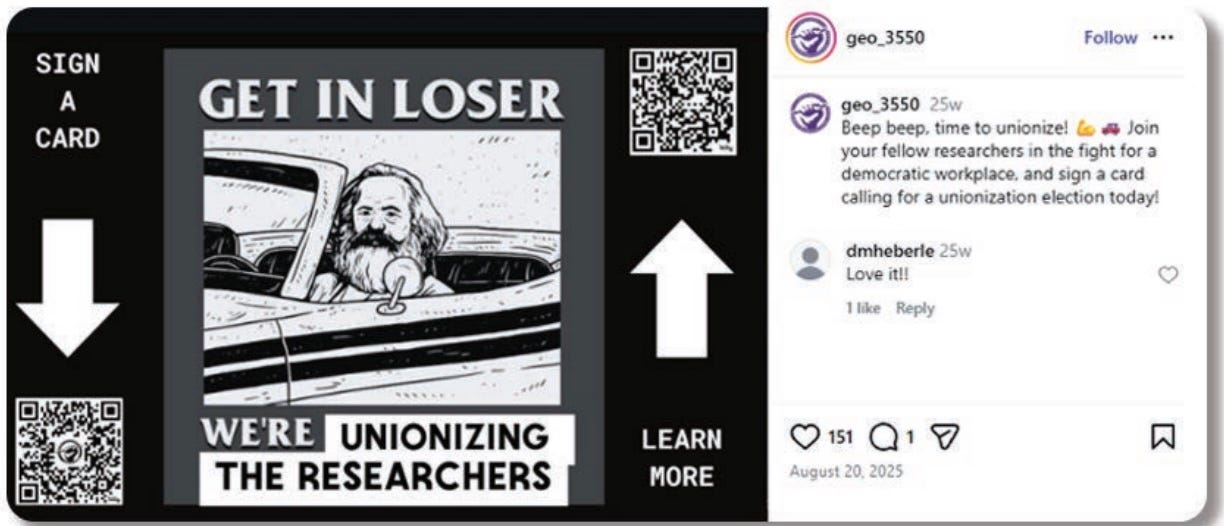
Jay Greene: Yeah, the convertible. It seems so decadent and bourgeois.
Well, it’s very Mean Girls. This was a reference to the Mean Girls movie; they put Marx in the driver’s seat instead of Regina George. I look at that, and I think, do they know that they’re peddling Marxism? Are they just cosplaying as communists? Is this fun for them, or funny? Do they understand what Marxism is, what communism is, what they’re pushing?
Jay Greene: I think a lot of it is cosplaying for sure. Some of it is enjoying the feeling of naughtiness, being transgressive. And some of it is just a glue that can help bring together people in their anti-Americanism and their antisemitism. Marxism helps with that.
Let me be clear, while I think the extremely high percentage of foreign students represented by these unions is facilitating this radical obsession with anti-Americanism and anti-Israel activity, there’s plenty of it also coming from domestic students. Native-born Americans are also joining in this, but frankly, it would be much less of an issue if it weren’t dominated so heavily by foreigners.
They are strengthening it and facilitating it in a very important way. And this has to do with why there are so many foreigners in U.S. graduate schools, which is another topic that is worth spending a little time on.
People don’t understand that the appeal of graduate students to universities is that they’re cheap workers. They help run universities. They teach intro classes; they run the labs. They are the grape pickers of universities, the cheap labor who do all the work that’s necessary for the university to function. It makes me mildly sympathetic to the idea that they might want to be represented by a union because they have terrible pay and working conditions. If only they had a union that actually cared about that.
It’s not a very attractive job for native-born Americans who have a lot of better opportunities in their lives and tend to go into things other than getting advanced degrees at American universities. Spending six years to get a PhD, living six-to-a-house in Somerville [or in a] run-down apartment is not very appealing to native-born Americans, but is very appealing to foreign students, not only because they tend to come from lower standards of living, but also because it’s simply a way into the United States without restriction.
The number of F-1 visas, the visa that allows foreigners to come and study at universities in the U.S., is uncapped. As many can come as universities want to admit. So over time, that number has risen dramatically so that we now have more than a million students in the U.S. with an F-1 visa right now. And that’s more than double what we had just when Obama was becoming president.
It’s just so attractive to universities to have this cheap labor, and very attractive to foreigners to figure out a way to end-run immigration law and get into the U.S. because there’s no vetting. Once you’re in, you never have to leave. You’re supposed to leave. You’re supposed to swear when you get that F-1 visa that when you finish, you’re going to leave, but we offer people endless opportunities not to leave, and so they don’t.
First, they can stay under the optional practical training program (OPT), and as long as they work in a field related to their studies, they’re allowed to stay up to three years on their F-1 visa. Then there are H-1B visas available for post-docs and other lab tech and teaching assistant positions or adjunct faculty positions.
Universities, unlike for-profit corporations, have an unlimited number of H-1B visas that they can sponsor. There’s no cap. Private corporations are capped at 85,000 a year. Universities can sponsor as many H-1B visas as they like. They have a ton of these F-1 visa holders who want to stay, and they’re willing to take frankly low-paying, not great jobs to run things at universities, being the postdocs, being the lab techs, being adjunct faculty, and they get sponsored with H-1Bs.
Right, and H-1B is three years, and then you can renew for another three years. So, six total.
Jay Greene: Maybe you’ve been in the U.S. for six years to get your PhD on an F-1, then you have three more years on an OPT. Now, you’ve been here nine years, and then with an H-1B, add another six. They want to come in and stay if they can. Some of them just want economic opportunities and enjoy the benefits of American life, which are numerous.
But some of them are coming with political agendas. They’re coming because they want to change America. There are things they don’t like about America. There are things about how America behaves in the world that they would like to alter to promote the interests of their home country. And they now have increasing opportunities to do this. They have the opportunity because when they work at universities, they teach the intro classes, they’re running the lab.
At the large universities. As a parent in the college search process right now, I’m assured by all the smaller universities that the classes will be taught by professors.
Jay Greene: Well, but sometimes the professor is an adjunct professor, with an H-1B. They move into academia at a very high rate, in part because academia has no limit on how many of them they can take. A quarter of all faculty in the U.S. are foreign-born.
Your report mentioned that in the larger universities that are more likely to have graduate students working as teaching and research assistants, 27% of graduate enrollment consists of international students. We’re talking about a big chunk of the graduate enrollment, and a big chunk of the faculty are foreign-born.
We’re a country that welcomes people from other countries. Immigration itself is not a bad thing. It can be a very good thing. And we have these legal processes in place. So we’re not talking about people who are doing anything illegal.
Jay Greene: No. There are benefits to American education from having foreigners come — they’re bringing talent, they bring different experiences from around the world that help enrich the education for native-born Americans who have exposure to those people from around the world. But originally, the idea was that we bring in people from around the world who would learn American political values, the virtues of the American political system, and then bring them home to their countries. But instead, the educational exchange is going in the opposite direction, which is, they’re coming, bringing their political values, bringing their political system, and then we’re exposing our children at elite universities, who will become the leaders of the American government, of American corporations, to the virtues of foreign political values and foreign political systems.
Speaking of elite universities, you cite Brown University, and apparently, foreign students with visas are more than 40% of graduate enrollment there. At the University of Michigan, 32% of graduate and professional students are there with student visas.
Jay Greene: In the Ivy League, between one-third and one-half of their graduate students will be foreign, and the unions are representing their interests. And their interests are clearly obsessed with the concerns of foreign powers and criticism of Israel.
Let me just give you a little feeling of this, just quoting from the head of the Brown Graduate Labor Organization. Sherena Razek, who describes herself as “A diasporic Palestinian feminist educator, scholar, activist, and labor organizer.” As president of GLO, the Graduate Labor Organization, she championed “the union’s decision to focus on divestment as a political goal.” It’s not surprising that’s something she wants. But it’s not really so much the wages, benefits, and working conditions that you might expect from labor organizers, those other things that seem to take priority. Labor organizer was last in that list.
Not surprisingly, they put together images that read, “Do not work for war, settler colonialism, and genocide,” and has images of tanks and says “Shut down the imperialist war machine,” “Hands off Venezuela, Iran and Cuba,” and then for good measure throws in “Free Palestine.” Then it says, “Fight fascism and stop the war on workers and our immigrant communities.” All things except wages, benefits, and working conditions

At the University of Michigan, the graduate employees organization like calling upon their faculty to engage in violent struggle against Israel. They have a post that they put up that shows an image of Edward Said, who was a professor at Columbia University throwing rocks at Israel. The message was, “If you have tenure, what’s stopping you?” And then the graduate employees organization adds, “Paging University of Michigan faculty” with eyes to indicate that they should join.
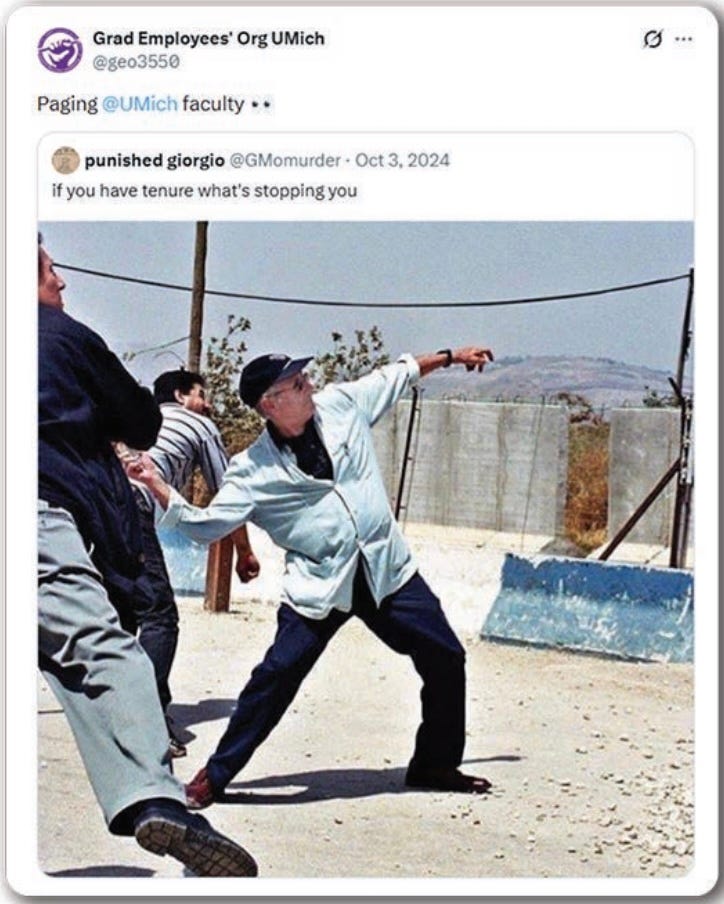
Again, people are allowed their political beliefs, and they’re allowed to express them. American citizens, I should add. Foreign citizens may have more limited political speech since they are here on visas with restrictions. For example, if you’re a member of the Communist Party or allied with a terrorist organization, you’re not allowed to receive a visa to enter the United States. You could be denied a visa. And that is not an infringement of the First Amendment.
Foreign citizens seeking to enter the United States don’t have a First Amendment right. Similarly, the belief is that if people were let in on those conditions, they could also be removed for the same conditions. They don’t have the same speech rights. They’re here as guests on temporary visas that have conditions not to engage in certain kinds of political activism that are contrary to American interests. Since they were let into the country in order to serve certain American interests, they can be removed if they violate that.
There are more examples that you’ve given here that are beyond what we might think of activism. Back to Brown University, their graduate labor organization’s Palestine Solidarity Caucus, posted on Instagram, “Joining student groups from over 100 universities across Turtle Island, so-called United States and Canada,” and went on to say what they were walking out to protest.
Jay Greene: The University of Michigan’s graduate employees organization frequently promotes messages from the Tarare coalition, which describes itself as “A movement dedicated to the liberation of all people. We advocate for resistance against systems of domination and struggle to destroy their manifestations at the University of Michigan, throughout Turtle Island, and across the globe. We act in solidarity with freedom fighters in Palestine and revolutionaries everywhere working to dismantle global imperialism, capitalism, white supremacy and patriarchy.”
And I hope they also are opposed to tooth decay as well. I mean, it would be helpful if they could address our moral and oral decay.
This is a lengthy list: imperialism, capitalism, white supremacy, patriarchy. They’re busy, these folks.
Jay Greene: Busy, but not with wages, benefits, and working conditions, which is what they’ve been recognized as unions for.
Let’s get to some solutions. We’re talking about the language, we’re talking about the images, the protests, and the walkouts. These folks are referring to each other as comrades and as revolutionaries. We’re not saying that immigration is a bad thing. We’re saying that these unions that have produced and cultivated this culture and activism, perhaps not a good thing. So what are some solutions to address these issues?
Jay Greene: Before solutions, our listeners might be thinking, “Well, college kids do that, it’s harmless. When I was in college, we did divestment and we slept in a shanty and it was really cool.” People have fond memories of their youthful protest, which makes them more indulgent of current protests.
These are things that people remember romantically, nostalgically, and they project it onto the current protests, the current students. And let me tell you, it’s not the same. This isn’t your shantytown that these people are in. These are people who are organizing with real hostility against the United States and traditional American political values in a very serious way, fueled by foreign resources and people.
This is a little bit more like Weather Underground, which we also shouldn’t romanticize. I mean, those people blew people up and killed people, sometimes themselves, accidentally. And they weren’t romantic figures at all. They were violent revolutionaries who lost badly, total losers. And these people are total losers too, but they’re causing quite a bit of damage as they do it. They’re poisoning our kids with crazy ideas that divert them from otherwise kind of productive adult lives that we might wish them to pursue. And they’re undermining the intellectual integrity and productivity of our leading universities that are supposed to help develop new knowledge and advance our understanding of the world, our economy. This is all a giant distraction and subversion of those worthy goals.
Things that are good in small doses are dangerous at higher doses. Foreign students on campus? Good at a reasonable dose, bad at a really high dose. Similarly, some campus activism and protest? Good at a small dose, dangerous at a high dose. If we can’t see the difference between this kind of innocuous small stuff and much more dangerous big stuff, we’re in trouble.
That’s why we need solutions. Just as policymakers after World War II recognized that unions were being hijacked for foreign purposes, I think that we could see graduate student unions as serving a similar dangerous function and might wish to impose similar restrictions. One thing we could do is require that they submit affidavits that they’re not affiliated with radical foreign movements. It sends a signal about the direction that labor organizations should take and that they should steer clear of the embrace of radical foreign agendas.
You’ve got some suggestions around using funding as a lever, as well.
Jay Greene: Universities have to recognize and facilitate these unions, and these same universities are the recipients of very large amounts of taxpayer dollars and subsidies, directly or indirectly. We can condition receipt of some or all of those subsidies on not facilitating these radical foreign-fueled graduate student unions.
Or we might simply decide that we don’t think it’s permissible to organize large numbers of temporary foreign workers. We wouldn’t want a union for tourists. Tourists enter the United States on tourism visas. They’re here temporarily. It would be weird if we organized them as a labor union. I understand they don’t have wages. But you understand the principle that these are people here temporarily from somewhere else. It would be strange to give them special privileges for expressing their preferences.
You’ve mentioned a couple of times that some of these categories of visas are not limited within higher education. So are you proposing to do anything on that front?
Jay Greene: In general, we need to make American universities American again, and not by eliminating foreign students and faculty, but simply by keeping the levels reasonable.
Placing caps on the percentage of F1 visas at universities is a totally sensible idea. Placing a cap on the number of H-1B visas that universities can sponsor seems eminently reasonable. And these would limit the foreign influence over graduate student unions and the culture of the universities as a whole.
Any other advice that you have for people who are tackling this issue?
Jay Greene: These are valued institutions that are major contributors to our society and our economy. We can and should rescue them, and frankly, the vast majority of people who attend university and work at universities are normal, sensible people and don’t want any of this stuff. They’re suffering from all of this as much as anyone else, more so because they have to live with it every day. We can help them.
Jay, normally, I ask my guests to share how to find their work, but I can go ahead and say you can find it on dfipolicy.org. And how can they follow you specifically?
Jay Greene: I’m on X, my handle is @JayPGreene. You can email me also through DFI (jay.greene@dfipolicy.org) if you have thoughts or comments. I’m always eager to hear what people have to say.
Related
PRESS RELEASE: DFI Submits Public Comment Supporting the U.S. Department of Education’s Proposed Accreditation Rules, Urges Several Changes to Ensure Due Process and Reduce Cost
WASHINGTON—Today, the Defense of Freedom Institute for Policy Studies (DFI) submitted a public comment on the U.S.
PRESS RELEASE: DFI Urges the Education Department to Investigate Four Women’s Colleges for Violating Title IX and Engaging in Substantial Misrepresentations to the Public
WASHINGTON — Today, the Defense of Freedom Institute for Policy Studies (DFI) filed complaints with the U.S.