PODCAST: | “Freedom to Learn: How Much Would States Have to Spend to Match the Competitive Effects of School Choice?
Patrick Graff on School Spending, School Choice, & the Benefits of Competition
“How should states invest limited education dollars to raise student achievement at scale?” A new report from the American Federation for Children asks this question, and the findings may surprise you. Patrick Graff, Senior Fellow with the American Federation for Children, compared the best research in the competitive effects of school choice programs and the best research on the effects of additional school spending on student achievement. He found that Florida’s school choice-rich policy environment benefited both public and private school students, and the effects of competition created a return on investment much larger than simply spending more on public schools.
Patrick began his career as a third-grade teacher in Florida and later served as associate director of the Alliance for Catholic Education (ACE) Teaching Fellows program. He received his Ph.D. from the University of Notre Dame, where he specialized in education and quantitative research methods. I thoroughly enjoyed our recent Freedom to Learn conversation and look forward to having him back soon to discuss his upcoming analysis of the impact of school choice programs on public school enrollment.
Please follow or subscribe to Freedom to Learn on Spotify, Apple Podcasts, YouTube, or wherever you get your podcasts. New episodes are released every Thursday.
This conversation has been edited for length and clarity.
Your research synthesis found that Florida’s investment in school choice is 11 times more cost-effective than increasing public school spending.
Patrick Graff: I was excited to release this new research paper, really building on the research that others have done looking at this question in Florida. There’s a professor named David Figlio who published this really famous study on the Florida program, looking at the first 15 years of the scale-up of what then was the Florida tax credit scholarship program.
He looked at it as it scaled from 15,000 kids in the program to over 100,000 kids 15 years later, and asked, “What was the result for public school students as a result of that program getting bigger?” This is considered one of the best studies on what they call the competitive effects of school choice. So, the competition effects you see in public schools in these high-competition areas.
What I did with this paper was take the results of that study, which found that kids in high-competition areas were 120 days ahead after 15 years, and compared it to the best research in the school spending literature and the research that folks will cite when they say “money works in education, we need to spend more on our public schools.”
So I thought, what if we took that same amount of money, went back in time, and said, “Florida legislature, we should take this money over the next 15 years and instead spend it on the public schools”? What would that have achieved for Florida public schools instead of taking this competition approach that they did take? That’s what the study does. It really puts these research literatures head-to-head, poses this hypothetical, and says, “If you took one path versus the other, what could Florida have looked like today in terms of that investment of resources”?
When I was running the Florida Department of Education school choice office about 20 years ago, Florida had three scholarship programs. There was the little Opportunity Scholarship Program for students who had been assigned to persistently failing schools. There was the McKay Scholarship Program for students with disabilities, and there was the Corporate Tax Credit Scholarship that was initially for students from low-income families. Tell us a little bit more about the Tax Credit Scholarship.
Patrick Graff: Corporations could make donations to scholarship organizations so that kids could use those funds and attend a private school of their choice in Florida. In return, those corporations would receive a credit on their state taxes.
This was a creative way for corporations to make high-impact donations to scholarship organizations, and kids, in return, got to have a new opportunity at a school of choice that they needed. At the time, the program was very limited. It was all low-income students who were eligible. You had to be switching from a public school to a private school in order to use it. So these were primarily what we would call “switchers” moving into the program. . There was a cap on the number of available tax credits that corporations could claim every year from the state. That kept the enrollment low in those early years. And it was a big political fight to just get small jumps in that program over time.
An interesting feature of this program, as it grew, is that an “escalator” was added. I don’t mean to get too wonky here, but the legisltures was able to include automatic growth in the amount of tax credits that were claimed every year for these corporations, which I actually think is an interesting and important part of the policy design. Every year, there was this constant pressure of an opportunity for more kids to join and to potentially use the scholarships. The program would hit capacity or very close to capacity every year. They kept increasing slowly over time until you eventually built over 100,000 kids, and it’s over half a million kids as of this school year.
And when we’re talking about today, we no longer refer to the tax credit scholarship. It has evolved into a broader education savings account program under a different name. Is that accurate to say?
Patrick Graff: That’s right. There’s a range of programs now. The Florida Tax Credit still exists, but it now funds a portion of the ESA programs. It is no longer just for private school tuition. You can now receive scholarships through education savings account (ESA)-type programs, where kids can spend those dollars, not just on tuition, but all kinds of other educational expenses. Most of the kids are still using it to attend private school. There’s the Family Empowerment Scholarship for Educational Options, the largest of the ESA programs. They also have the Family Empowerment Scholarship for Unique Abilities for kids with special needs. And there are over 100,000 kids with disabilities in that program.
The McKay Scholarship Program I mentioned from 20+ years ago is now this ESA for students with unique abilities. There’s also the PEP for students who are homeschooled.
Patrick Graff: Yes, the Personalized Education Program, that’s one of the newest ones, and that one is growing rapidly, as well. There is still a cap on the number of folks who can take advantage of that, but it’s rapidly approaching 100,000 kids in that program.
So, a lot of different options. With both the PEP and just having ESAs available more broadly, that’s bringing choice to all parts of the state that you didn’t have previously. When you had the smaller program, it was mostly urban areas where you might have easier access to a private school. Part of what they’re doing in studying competition is comparing the high-competition areas versus the low-competition areas.
Now we’re in a world where there’s competition everywhere, which is interesting to think about what might be happening now versus the period of this study. These small school experiments, a lot of people will call them microschools. You might have 10, 20, or 50 kids run by a former public school teacher in more rural areas. That wasn’t a possibility as much back then, but now it is, I would dare say, fairly common in more rural areas in Florida.
Let’s talk about your story before we talk more about the research. You were a teacher in one of these schools where students were benefiting from the Corporate Tax Credit Scholarship Program.
Patrick Graff: That’s right. I had just graduated from college and was a new teacher teaching third grade in Tampa, Florida. I didn’t know it at the time, but my kids were part of a big experiment in Florida education policy, in that many of them were only able to attend our school because of the tax credit scholarship program.
I remember Step Up for Students, one of the big scholarship organizations that helps run all of the school choice programs in Florida, had folks coming to our school talking about the program, talking about the students. I didn’t know a lot about school choice at the time, but I knew that our school was really grateful to have that possibility.
There was a public school less than a mile down the road from our private school. It was very interesting, in hindsight, that those kids were actually benefiting in many ways from the fact that these kids had options. It wasn’t as though there was a mass exodus from that public school down the road, but every year, there would be a couple that trickled into our school and took advantage of another option.
There are a lot of myths perpetuated about school choice, and I think kids on both sides of this really benefited, including a lot of the ones in my class.
Figlio did a number of evaluations of the program looking at the test scores of the private school students, but we’re talking about the research he was doing on the competitive effects. And it wasn’t just higher test scores that he found for traditional public schools located in the higher-competition areas. There are some other benefits, too.
Patrick Graff: That’s correct. In his study, he looked at the achievement outcomes, so reading and math scores. But interestingly, they also had access to discipline data and attendance data. They found that public school kids in high competition areas over time had fewer disciplinary incidents and had better attendance as a result of these competitive effects, as well, which had not been tested to that point in the competitive effects literature.
Both of those are huge findings that people should pay attention to in a post-COVID era where we’re seeing much higher rates of disciplinary issues in public schools and alarmingly high rates of chronic absenteeism, which means that students are not learning.
So you took the Figlio research and then looked at another set of research on the impact of additional public education spending. Tell us about that body of research.
Patrick Graff: This has been a big debate going back in the education research literature for a long time. Does school spending work, and at what level? How much of a return are you getting for that investment? At a certain point, there are diminishing returns on additional spending within public schools. Resources definitely matter. We know that you need some amount of resources to run a school, obviously. But at a certain point, does it make sense to just increase education budgets, or are there more targeted, very specific interventions that we know are going to make a big difference that are worth investing in, and doing that very selectively?
On both sides of this debate, you have folks saying how you spend the money really matters a lot. But several of these economists try to make the point that even when you do general increases to education budgets, there is a positive impact.
One of the most important and most cited studies in the school spending literature is this meta-analysis of 31 studies of school spending research that takes the findings of 31 studies and combines them, and says, “Here’s our average effect of spending based on the most rigorous research that’s ever been done on the effect of these school spending reforms across the country.”
What they found was that for every additional $1,000 per kid per year that you spend, you will increase student learning by about five to six days of learning out of 180-day school year.
Give us a sense of what average per-pupil spending is. When we’re talking about adding $1,000, that’s on top of what?
Patrick Graff: As of this school year, we are approaching, if not exceeding, an average per-pupil amount of about $20,000 per year, per kid in the United States. This study was all done in 2018 dollars when they were doing this analysis. But if you were to bump that up a thousand dollars or a little bit more today, you would expect a little bump in how much they are learning that year.
The result of that is, yes, spending more money can result in more learning, but it’s a small gain for a fairly large cost. It’s hard to scale that to say, if a kid is 180 school days behind—a year behind—if you try to just use the school spending approach, that’s going to be tens of thousands more dollars per year, per kid, which becomes prohibitively expensive very, very quickly.
There are all kinds of interventions that we can try. We can think about tutoring. We can think about smaller class sizes. We can think about other educational interventions that might work. And the issue with a lot of those is that tutoring works really well when you have a fairly contained, small program. We know it’s one of the most effective interventions for education.
So, let’s say you have a tutoring program that’s implemented at a school that’s affecting a couple of hundred kids. Those programs, especially well-run ones, can have a huge effect for a pretty modest cost. That’s going to be pretty successful. If you try to scale that up to 1,500 kids, the efficacy cuts in half. If you just look at the research literature on tutoring, as you scale the programs up, it is very challenging to maintain your efficacy. If you try to go to 5,000 kids, you can almost cut that effect size in half again.
If you try to think about bringing an intervention to the level of a state or even half of a state, which is what this competitive effects research literature is looking at, you can’t implement a tutoring program at the scale of half of a state. You don’t have people to hire who can implement that well. You don’t have good implementation fidelity. Historically, in the education research literature, as interventions scale, efficacy goes down, and cost goes up.
That is what you find in education research. The fascinating thing about competitive effects, and particularly what we found here in Florida, is that as the program scaled, the efficacy went up and the cost went down. The cost effectiveness actually got better as the program got larger, which is completely opposite of what you would expect with most educational interventions.
You were looking at the Figlio research that shows the positive competitive effects of this growing program in the state of Florida. And then you were looking at the effects, which turned out to be positive, of spending money, a lot more money, if you’re talking about the ESSER funds during the COVID era, when there was $190 billion in supplemental federal funds.
Patrick Graff: That’s right. I included the ESSER funds, as well, because when you can’t scale those other inter-educational interventions to the scale of a state or even half of a state, your option really is to spend more money. That is the default right now for many states to say, “How do we do system-wide improvement?” And, in some ways, that experiment was tried over ESSER.
So that $190 billion that we distributed across the country, they did two evaluations of that additional school spending, and interestingly, the impact was very in line with the results of that meta-analysis, if not a little worse — five to six days of learning or a little bit less. One of the impact evaluations found no gain for reading as a result of this, but a bump in math.
Strikingly, one of the authors in the study said, if you want to use the school spending approach to return student achievement levels to pre-pandemic 2019 levels, we would need to spend an additional, on top of the $190 billion, $450 to $650 billion dollars just to get back to where we started before, where there was already all kinds of gaps between kids achieving at high levels and low levels. That was using the estimates from their study.
Interestingly, folks on the school spending side will summarize this and say, well, they did find a positive impact. School spending works. And when the Biden administration’s Council for Economic Advisers put out a post following the ESSER investment, they said, “these papers show that, yes, our money did have a positive impact on student achievement.” And I don’t deny that. I think it did. But the question is, that is a tremendous amount of money for a fairly small gain.
We need to be honest with ourselves and the advocate community that cares about education for all of our kids. What are other investments we can make that provide outsized returns that are going to do a lot for less than that?
We started by saying that you found that Florida’s investment in school choice is 11 times more cost-effective than increasing public school spending.
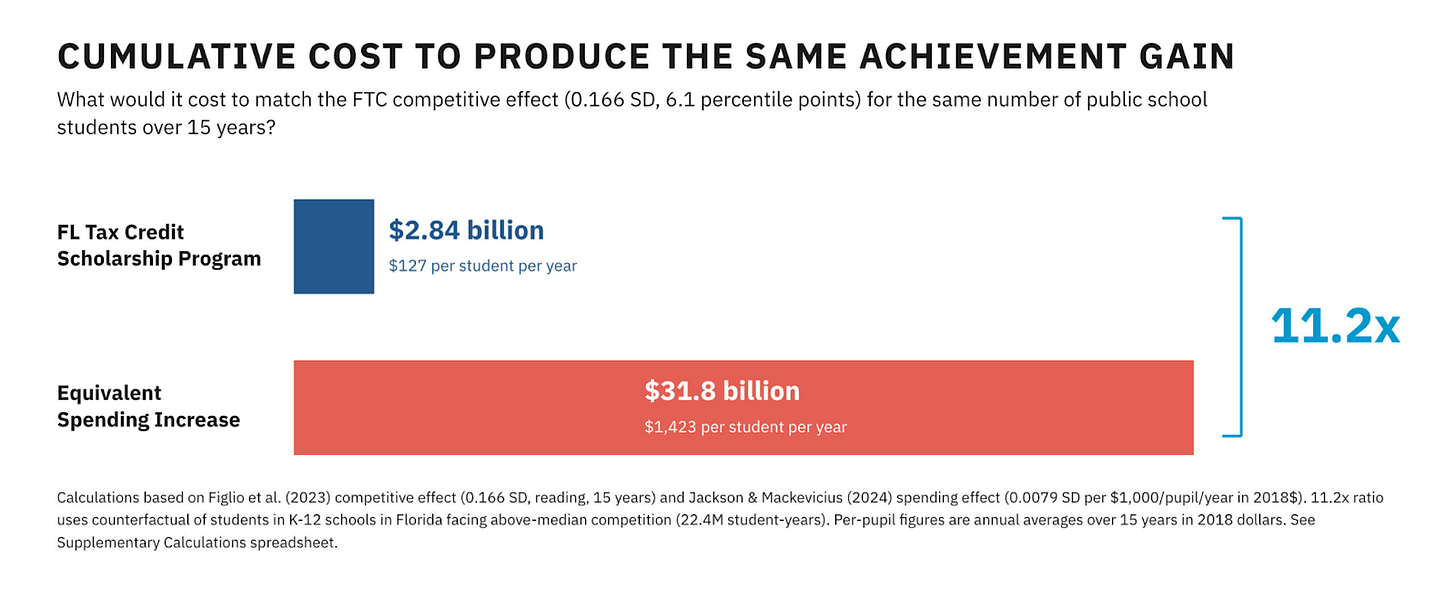
Patrick Graff: What I did is, I brought these two research strands together and, using the results from the Figlio study and then using the results from the Jackson and Mackevicius meta-analysis that was also published in 2024 — both of these are fairly new studies — and just said, let’s put that head-to-head.
We know the Florida tax credit scholarship was a $2.8 billion total investment over 15 years to give all those kids scholarships. After 15 years, that resulted in 120 days of learning for the 55% of kids in high-competition areas around the state. That’s over a million kids who experienced that bump.
It’s a lot of money, right? Over 15 years, that’s a tremendous amount of money. And they were able to achieve that for less than $3 billion through the competitive effects approach.
So you were conservative, cautious in your assumptions in coming to this finding. You said that the true ROI, the true return on investment, is likely larger. What do you mean?
Patrick Graff: That’s right. That’s what I found most striking about this. I was expecting to find a smaller multiplier than this, but I tried to be as generous to the school spending approach as I could, and completely transparent about the calculations I’m making, as well as my assumptions.
The assumptions do not include things like the fiscal savings of school choice. So we know when a student uses a scholarship to transfer from public to private, the state spends less money on that student. The scholarship size is often much less than what the state spends on per-pupil funding in the public schools, often less than half. So, any difference there is savings to either the local school systems or to the state. Those cost savings are not included in this analysis.
Another big one is that the way you do these competitive effect studies is you’re comparing low-competition areas and higher-competition areas. You are not able to capture the effect of how much competition affected everybody. If everybody went up and there was a competition effect there, but the high competition areas went up even more, you cannot capture that baseline, what they call an equilibrium effect of how it moves everybody up. That’s not captured in this study design either. I was trying to be very generous to the school spending approach. When you spend money at that scale, it is difficult to do well. And because of that, you might lose the additional efficacy of spending that money at scale over 15 years.
I assumed that it would maintain its efficacy over 15 years, that every year they would use that money in a smart way, and continue to hit that return. In the real world, with education politics and the realities of school systems, would that happen everywhere? It’s hard to believe that it would. So in that sense, it’s a pretty powerful argument for why this might be closer to a lower bound than an optimistic projection.
You do say that in Florida, the strength of the effect grew with the program size. This idea that bigger is better is something that’s relevant when we’re talking about states that are offering universal education freedom. And you mention the new federal scholarship tax credit, which has the potential to expand school choice nationwide on a scale we haven’t seen before.
Patrick Graff: You have to look at these states that currently have no private school choice programs. There are 18 states with no private school choice. I think some of them will opt into the new education freedom tax credit. So the exciting news for them is that their students will, for the first time, have access to scholarships that they otherwise would not have access to. But also, their public school students will benefit because there will be new competitive effects over time, especially as the Education Freedom Tax Credit scales up.
As you know, the Education Freedom Tax Credit is not just available for private school students, either. Public school students will also be able to directly benefit through tutoring, special education services, and transportation, as well. It really, in my mind, makes complete sense and would benefit all of your kids to opt into this.
That program is more generous because it doesn’t cost the state anything, either. This is a federal tax credit. So it is revenue that wouldn’t come into the federal government, but instead scholarship organizations are going to be able to supercharge the impact of those donations and give scholarships out to kids who need them.
For those 18 states, I would say it is in your best interest to opt into the program because everybody’s going to benefit. The argument that this is somehow going to harm public schools because you might lose a few of your students is really undermined by this evidence in Florida.
For a lot of the states that currently have school choice programs, and especially those that are capped, there’s a lot you can take away from the Florida experience. First is to keep up the pressure. There is a temptation over time to basically say, let’s bail the public school system out whenever we create a choice program. One of the Tennessee ESA programs, when they passed it, included a “hold harmless” provision for Tennessee public schools — if a student leaves, they just pay for that student anyway.
Especially in some areas, you actually want your principals and your district leaders to be thinking, “Are my parents satisfied? Do my parents want to send their kids to the school here?” And if there is no incentive for them to pay attention to that, because they know that it doesn’t matter how many kids leave, we’re going to receive at least the amount of funding we got last year, and the coming year, that really undermines the competitive pressure.
Part of what Florida demonstrated is that getting the incentives of your education system right really matters for effective spending. If you have a system that just allows people to drain through the system and there’s nothing keeping the education spending focused in productive ways, you’re going to have a lot of challenges.
You list the benefits of public schools responding to that competitive pressure. They might allocate resources more efficiently, become more responsive to parent concerns, adopt new instructional strategies, invest in effective teacher development, and differentiate their educational offerings to better attract and retain families.
What’s the big takeaway that you hope policymakers and others will have in reading the study?
Patrick Graff: The big takeaway for me is that school choice is not a zero-sum game. That is often how opponents of these programs will frame it. They will say, “You can either fund school choice programs, or you can fund the public school system. It’s really one or the other. It’s either you’re going to benefit these private schools, or you’re going to benefit these public schools.” They really set up this either/or high-stakes competition.
In contrast, what Florida found was that you can do both. Investing in the private school choice program there was an intervention to help the public schools. We should think about it as an intervention for improving educational outcomes for students across the state, and particularly your lowest-income students. And I hadn’t mentioned this yet, but David Figlio and his co-authors found that the effects were even larger for low-income students in Florida. So they gained 140 days of learning after that 15 years.
In conclusion, “this is an incredibly cost-effective method of raising public school achievement, especially at scale.” You’re dispelling this myth that school choice hurts public schools. And is there another one, a little bonus myth that you wanted to tackle today before we wrap up?
Patrick Graff: I’ll give you a sneak peek at my next research paper I’m working on. It’s a paper looking at school choice expansion to universal around the country, and looking at what happens to public school enrollment as a result of universal expansion. There’s been a lot of talk in the last year, in particular, about declining enrollment in public schools around the country. Oftentimes, the private school choice program in those states gets blamed as the reason why public school enrollment is down, why everything is going terribly in the public school sector.
And no acknowledgement that people stopped having as many babies in 2008, and we have a significant demographic cliff.
Patrick Graff: That’s right. There are a lot of other factors that influence how many kids show up for school every year. There was a big report put out by Doug Harris last fall looking at the expansion to universal and impacts on enrollment and tuition in private schools. They focus on the private school side; we’re focusing on the public school enrollment side.
What we find is that there is no impact on public school enrollment on average in states that move to universal programs. Part of that is because universal states tend to be the states that are growing in terms of student population overall. So, you look at a place like Florida, for example, [which has] the country’s largest private school choice program, over 500,000 kids using it, their public school enrollment has actually grown by almost a percentage point since 2019.
In contrast, if you look at states like California and New York, they have no private school choice programs, and their public K-12 enrollment has dropped by more than five percentage points since 2019. They have seen the largest declines despite having no private school choice program. So we actually think that this is a huge myth that this is a contributor to public school enrollment decline.
I do think in some places it can be having a small impact, and that’s definitely true. But often, there are other dynamics, both within and across states. Things like how many people are moving into your state versus moving out of it, in addition to birth rates that are patterned by state, have a much bigger impact on K-12 enrollment.
When can we expect to see that study?
Patrick Graff: This May, hopefully, it’ll be out for public consumption.
Okay, we’ll have you back to walk us through the details. How can people follow your work?
Patrick Graff: There’s an Education Next article that came out, it’s called ‘School Choice or School Spending.’ You can also follow me on X at PArthurGraff. Also visit FederationforChildren.org, you can find the study there.
Access our full conversation on your favorite podcast app. Please follow Freedom to Learn on Apple Podcasts to receive new episodes every Thursday morning!
Related
PODCAST: | “Freedom to Learn:” It’s Time to be Honest about IDEA
Debra Tisler on IDEA at 50, Due Process Costs, & the Fight for Services for Students with Disabilities Last November marked the 50th…