PODCAST | “Freedom to Learn:” New York City’s $42,000 Per-Pupil Dilemma
Danyela Souza Egorov on NYC’s Soaring Spending, Plummeting Enrollment, & Chronic Absenteeism.
New York City spends $42,000 per pupil, but student outcomes are mediocre, and families are fleeing the system. Danyela Souza Egorov joined Freedom to Learn to discuss the city’s shrinking enrollment, increasingly empty school buildings, and soaring spending. As a Manhattan Institute fellow, Vice-President of New York City’s Community Education Council District 2, and the founder of Families for NY, Danyela regularly urges New York leaders to make responsible decisions, tackle the city’s chronic absenteeism crisis, and prioritize students and families rather than powerful unions. Our conversation also covers foolish COVID-era policies that reshaped public education, why parents are demanding more options, and what the federal scholarship tax credit could mean for New York families seeking educational freedom — IF Governor Kathy Hochul officially opts in.
Follow or subscribe to Freedom to Learn on Spotify, Apple Podcasts, YouTube, or wherever you get your podcasts. New episodes every Thursday.
This conversation has been edited for length and clarity.
We’re going to talk mostly from your perspective as a Manhattan Institute fellow, but you have gotten involved in education in New York in other ways. Can you talk a little bit about your other roles?
Danyela Souza Egorov: Yes, I started getting involved in education through charter schools. So I started my career at Boston Public Schools, and I was responsible for helping create the first in-district charter. And I watched the impact that the charter model had on a school that was previously failing. And so then I spent the next 10 years of my career just really helping educators create charter schools.
Then I had kids of my own and started dealing with public schools in New York City. The year that my son entered a really wonderful gifted and talented program here was the year that Mayor de Blasio tried to start to dismantle those programs. I got very involved in the gifted and talented fight here and got elected to the community education council, the equivalent of the school board here in New York City. I’ve been serving on that board for five years and helping parents there and started to write about education. I, especially during COVID, was so frustrated about the lack of coverage about what was happening to our kids and the school closures. That’s how I became a researcher at the Manhattan Institute.
In that time, things have changed in New York for a variety of reasons, and families have left the public schools due to their displeasure with how things happened during the COVID years. They’ve moved out of the city for a variety of reasons and we have the “birth dearth.” You’ve been writing about these New York City enrollment trends and the fact that the budget is going up while projected enrollment is going down.
I listed some of the reasons that things are shifting with enrollment. What’s the comprehensive list? What’s driving this decline in enrollment in the city?
Danyela Souza Egorov: I think it’s a combination of factors. Definitely, demographics is a huge factor. The city today has roughly 25,000 fewer births than it had 20 years ago. So there are just fewer kids in the city to begin with. On top of that, many families, particularly with young kids, are choosing to leave the city. We saw just a year ago a huge drop in the number of pre-K and K students. The city lost 3,500 students just in one year in pre-K and kindergarten, which I think is a good indication showing that when people are about to enter kindergarten, they are leaving the city, right? New York has a huge out-migration problem, and that, I think, includes a lot of families with kids. But there’s also the fact that people are leaving the public schools, even the families that are here. We have seen a dramatic increase in charter schools. Really, families are choosing more charter schools. Homeschooling has grown a lot since five years ago, even though New York is a state that is not very friendly to homeschoolers. And particularly this year, I think this is a new trend: private schools have seen a huge increase in applications as well.
I think it’s a combination of factors — of demographics, but also families are not happy with what New York City public schools are offering to them.
When it comes to the birth dearth, to the demographic cliff, this isn’t just a New York City problem. My spiel is that people stopped having as many babies in 2008. Is that how you describe it? Or do you have a more technical way of describing what’s happened?
Danyela Souza Egorov: So in New York City in particular, there is a huge drop in the number of births, particularly right after COVID. That’s where we see a big, big drop. But it was kind of a steady trend downwards, if you look at the last 20 years. But I think COVID really accelerated that trend. But I agree with you; it’s not just a problem in New York City.
I think being the mayor or the school chancellor in a large urban district over the next 20 years is going to mean managing decline in enrollment. And that will probably include a combination of closing schools or really trying to make your school so attractive that you can at least have stable enrollment.
That’s not what’s happening in New York City. You wrote in a piece recently about decisions that actually do the opposite, right?
Danyela Souza Egorov: The New York City education budget is just a conundrum because the budget keeps growing. It has grown by at least a billion dollars every year for the last five years. And this last proposed budget includes a growth of $3 billion. So we’re going to be around $38-39 billion in the budget. At the same time, we have had a huge decline in enrollment.
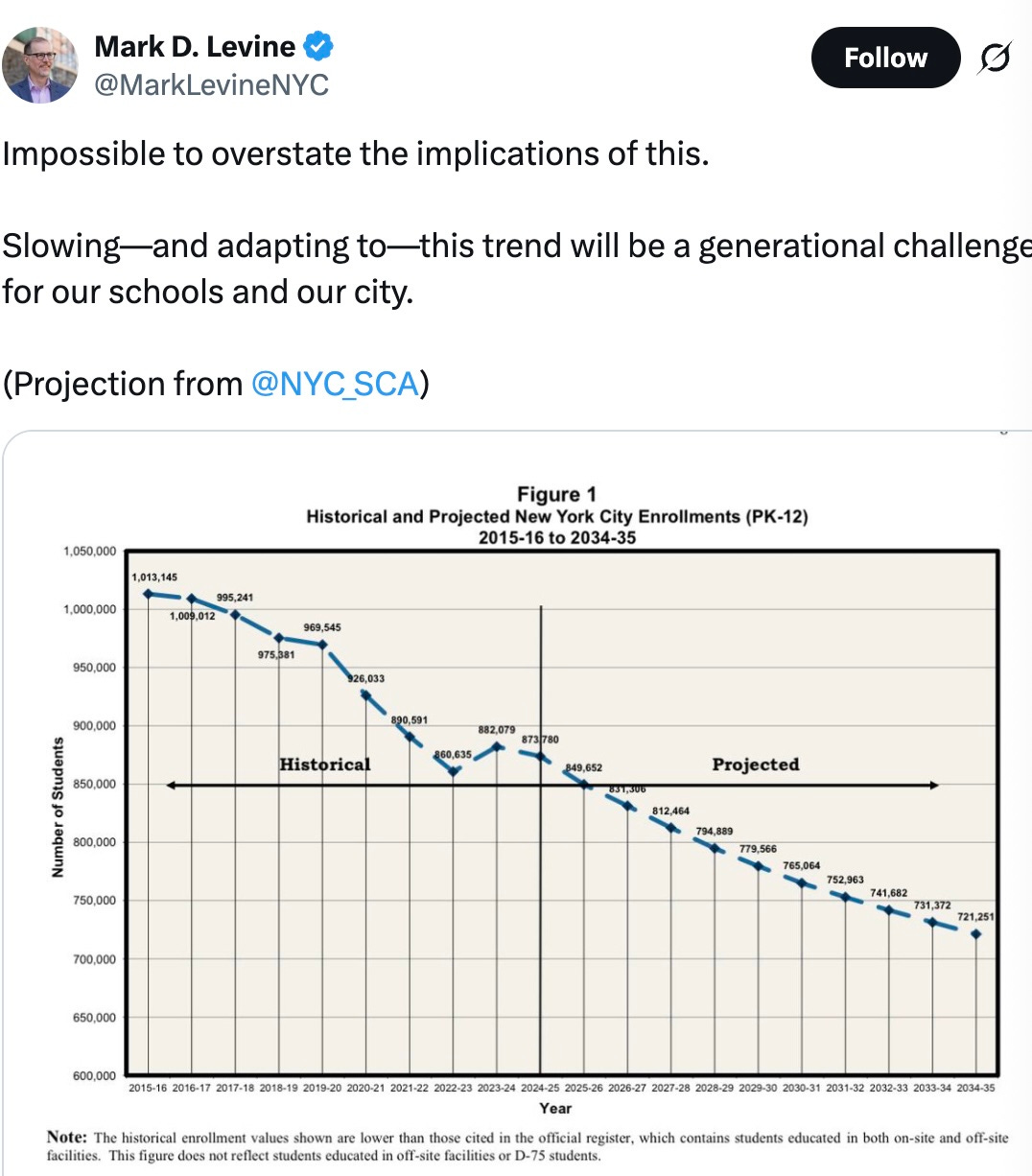
The school construction authority just put out a report saying that they predict that over the next 10 years, New York City is going to lose 150,000 students. That will make the district roughly 650,000 students. In a period of 15 years, the district will become literally half of what it was before COVID.
I always joke that if all this money was getting us amazing academic results for our kids, I would not be writing. But our results are mediocre. We’re middle of the pack on NAEP, and it’s not getting better. The schools are getting more and more money to educate fewer kids and producing the same mediocre results that we had before COVID.
A big part of this is because the budget of schools is not tied to enrollment anymore. It used to be before COVID; but now, some schools experienced such a dramatic drop in enrollment, the city did what they call “hold harmless” policies, which was supposed to be a one year policy, but it has become permanent now. It costs the city roughly $400 million every year to keep these schools floating, even though they have experienced dramatic enrollment drops.
When you say dramatic enrollment drops, keeping the schools going, they’re holding schools harmless even though the schools are at less than 60% capacity, less than 50% capacity. You’re talking about buildings that are really emptying out, right?
Danyela Souza Egorov: Yes. Roughly one-quarter of our schools are operating below 60% capacity. They are unintentional microschools. This year, we had 112 schools that were projected to have fewer than 150 students. And next year there are going to be 134 schools. It keeps growing every year, the number of schools that are going to have fewer than 150 students. And a few of these schools are designed to be small because they are serving specific populations, maybe with special needs, but the vast majority are small because of enrollment decline.
I’m trying to understand the governance structure in the city. Is there an office that is saying, “Look, we’ve got to tackle this?” The city comptroller, I think, was acknowledging that this is a reality. Does he have any power in the governance structure?
Danyela Souza Egorov: We have a new city comptroller this year who has been doing, I think, a really remarkable job, especially compared with our previous comptroller. He’s trying to say, “Look, pay attention to these problems in the fiscal situation of the city.” And the DOE is a big part of that. The Department of Education represents one-third of the budget, roughly, of the city.
He has pointed to a number of things that are driving the increasing costs. He talked about the dramatic increase in spending on what’s called “Carter cases,” which is when families sue the district because their students with special education are not being served. So then the city has to pay for private school for these students.
The current chancellor was a school superintendent before, and he managed declining enrollment. He proposed some mergers. He proposed some closures, but he had to pull back on that because school closures are very difficult. My first job at Boston Public Schools was to close schools. It was a baptism by fire. I know how hard it is. I’m also very cognizant that it really has an impact on students. But I think, unfortunately, for New York City and many other districts, this is a reality that we cannot avoid.
Not closing schools is going to become more damaging to students because we’re spreading the budget so thinly across so many schools that are half empty and we’re not delivering the best education that we could for our students.
Who ultimately makes these decisions? Outside of New York, we only hear about the mayor, but you’re talking about a complex, massive system within a complex, massive city. The comptroller is calling attention to it. You have a role as a school board member. Is it up to the mayor, ultimately, to make a fiscally responsible decision?
Danyela Souza Egorov: I think it’s a combination of the mayor and the city council that really decides the budget of the city. But specifically for education, we have what’s called the Panel of Education Policy (PEP). The board that I serve on is just an advisory role. All the parents are only in advisory roles on the community education councils. But the PEP really is the one that makes decisions. The people who are there are appointed by the comptroller, by the mayor, the borough president. We have five boroughs, and each president appoints one member there. It is a very, in a way, decentralized infrastructure.
In the governance model, you cannot just say it’s one person, but I think definitely the mayor has a leading role. He appoints the majority of people in the PEP, and he could definitely make sure that this is a priority for us to really right-size the district and then allow us to make investments in the schools that we know are delivering good results for kids. There are schools in New York City that are over-enrolled. There are schools that have waiting lists that people want to be expanded. But these are very difficult decisions, but I definitely think that it is the mayor who has the ultimate responsibility here.
What role do parents play in this? Like you said, school closures and school consolidations, that’s a tough thing to pull off. And often, it’s parents pushing back and saying, “Wait, that’s our neighborhood school. We moved here for a reason. We’re connected to this. We have history here.” How do you communicate to parents, who are also taxpayers, that we’ve got to do this?
Danyela Souza Egorov: Parents are speaking in the most profound way when they choose a school, right? People are not choosing these schools. And if they are, it’s a very small number.
The city has had this experience before. There was a school in Brooklyn that at some point was not even designated as a school anymore; it was a program because it became so small that it just was not viable anymore as an actual school. But the city waited until that happened to then close that school. The fiscal situation of the city was very different at the time. Now, we are having more fiscal challenges, and our expenses are growing faster than the income that the city takes. The city will not have the ability to deal with this problem in a slower way.
What’s the role of the teachers unions? Obviously, they don’t want any employees impacted by budget cuts or fiscal responsibility. In fact, they really pushed for a class size cap that would drive up their union rolls. Is anyone in the union acknowledging the problem here, or are they contributing to the problem?
Danyela Souza Egorov: They’re definitely contributing to the problem.
Unfortunately, in New York City, the teachers unions have such an outsized role. Basically every decision that the DOE makes, you can trace back as benefiting the union’s interest.
Right after COVID, when there was that huge drop in enrollment, they pushed for this class size law. It was exactly what it said. There is now a new cap in the number of students, and it is a law that is applied across the board. There are no exemptions at all levels. We have been on a hiring spree, even through declining enrollment. The most absurd thing is that they are trying to now implement this law in schools that every single seat is filled because there’s so much demand for that school and the buildings are full. There’s no space to create new classrooms. And the only way to implement this law, and some people have actually advocated for this, is to limit enrollment. So, to admit fewer kids to those schools.
I always give the example of Stuyvesant, which is our most prestigious high school here. They take roughly 800 students every year. To implement the class size law, you would have to admit fewer students. That would be insanity because we would literally be limiting the number of students that have access to this really high-quality education in our city just to benefit the teachers unions. Everybody in that building is getting access to an excellent education. There are so many kids applying who would love to be there.
It’s not just Stuyvesant. There are a number of schools that are in this situation. And the only way to implement this law is going to be by limiting enrollment. The previous chancellor under Mayor Adams said that she would not allow limiting enrollment to implement the class size law. This chancellor has not said this yet, explicitly at least. We don’t know what’s going to happen. The good news is that the city cannot afford this law, so the mayor has negotiated in the latest budget negotiations to have a slower implementation timeline. It’s going to be a little bit of a pause.
I have said many times that this law is impossible to implement. It’s too expensive. There is no space in the buildings, and we’re not going to be creating new school buildings on time to actually implement. Most importantly, the schools where you would have to implement, you can only do by limiting enrollment. The day that they actually try to do this, the reaction from parents, when they are being told, “You cannot go to this school because of class size law,” I think there’s going to be a huge backlash.
Are there other examples of things that you’ve seen teachers unions doing in the city that are harming students and student outcomes?
Danyela Souza Egorov: I think overall they have been pushing for lowering standards, for less testing. And New York has, at the state level, has lowered graduation requirements. It has lowered the standards for you to be proficient on state tests since COVID. They explicitly said at a state board meeting that they were going to accept that this is a “new normal” after COVID, and reset the proficient level.
I had a first grader when they were doing this, and I remember thinking, “I will never hold my first grader now at a lower level than my kid who is now in fifth grade.” It’s crazy as a mother to now say, “That’s the new normal. We’re just gonna have to expect less from you academically.” No parent will do that, but that’s basically what the state was telling parents.
They made it easier to pass the state test in order to hide the learning loss from COVID. All the things that are being pushed by groups that are funded by the teacher unions, and by legislators who receive contributions from the teachers unions. Overall, there’s a damaging impact on the New York children.
You’ve written about chronic absenteeism, something that does not get the attention that it deserves. After COVID-era closures, it doubled on average nationwide from 15% to 30% of students chronically absent. Chronic absenteeism means that you’re missing at least 10% of the school year, and it’s probably a lot more in many cases. The cities were hit really hard with chronic absenteeism. What have you seen in New York on that front? Is it abating at all?
Danyela Souza Egorov: The increase was so high. As you said, my report looked at two years ago, and roughly a third of kids in New York City were chronically absent. That means you’re missing one school day every two weeks. People always say, “People are now taking more vacation.” That does not make you chronically absent. You need to be consistently missing days.
It’s getting a little better, but not enough. It’s dropping one or two percentage points per year, which is not going to get us to where we were before. As Nat Malkis from AEI always mentions, it was already very high before COVID. Now, it is extremely high across the board.
In that research, what really surprised and made me so worried is that the chronic absenteeism was very high even in early grades —kindergarten, first grade. That is very worrying because these kids are not going to school by themselves. There is an adult or caretaker that is making the decision that the child is not going to school. We have so much research that shows that if you are chronically absent in the lower grades, the likelihood that you are not going to be able to read in middle school and high school is striking. We’re setting up these kids to fail in school and in life later on.
This is the most important issue for us to solve a number of other issues in schools. I am deeply worried about academic performance. We’re not going to improve academic performance if we don’t deal with chronic absenteeism.
There was a message from school districts that schools were a dangerous place during the COVID era. “Stay home. Your child will be sick. They will be a vector for disease. They will make vulnerable adults sick.” I don’t know that anyone ever started sending a message otherwise, even when the school buildings opened up again. Would that be one of your solutions that you’d propose to tackle this?
Danyela Souza Egorov: I think it’s even worse because, in New York City, schools were closed when bars, restaurants, gyms were all open. I could go to the restaurant to have dinner with a friend. I could go to the gym. My second grader could not go to school every day. What that message is, is that school is not important, that school is not essential, that the restaurant industry was more important than kids getting an education. I do think that in a lot of cities, our society absorbed that message, right? That it is not important. It’s not essential. We’re not going to prioritize this.
Our elected leaders did not prioritize education and children during COVID. I do think we’re still dealing with the impact of that.
There’s hope out there. We talk about the Education Freedom Tax Credit, the federal scholarship tax credit, a lot on this podcast with our guests. There’s news out of New York for families who are exploring options to residentially-assigned public schools. They might have additional opportunities to do so when this federal scholarship tax credit kicks in next year, IF the governor opts in. The governors have to say, “Our state is in; students in our state can benefit from tax credit-funded scholarships.” There are different interpretations of Governor Hochul’s position on this. What’s your take on it?
Danyela Souza Egorov: She has said in a meeting that she intends to opt in, which is a really great sign. Now, we need to see it actually happening. Her staff said that they were going to look for poison bills when the regulations come out, which I think is late summer. So, it’s not a done deal yet. But I do think that she talked about her intention, and I think that is driven by the fact that it’s a no-brainer for states like New York and California to opt in to the federal tax credit.
New York and California are two of the top three states that pay federal taxes. Regardless of whether New York and California opt in or not, our taxpayers will be able to donate, and they will donate to this program. So, if we don’t opt in, the money is going to benefit low-income kids in other states.
I have friends in smaller states who are like, “I really hope your state does not opt in because that will be very good for my state. Because we’re gonna get all this money that you guys are gonna pay, and it’s gonna benefit low-income kids in my state.”
It really is a no-brainer. What is really important for people to understand is that it does not mean a “voucher” program. This is a program that will benefit even public school students with other educational expenses. So even if you’re a public school or a charter school, you can still benefit.
God knows our kids in New York need extra tutoring and help with other expenses. The New York Times had an article recently about how much money families are spending with other educational expenses and are really struggling. It’s really hard for many families. That would be such an important help. And I definitely hope that Governor Kathy Hochul and Governor Newsom will opt in.
What can families and community members do to hold her accountable, to ensure that she does?
Danyela Souza Egorov: It’s important to tell her that you want this. It’s really important for families to reach out to the governor. I had the link on my website on how you can send her a message. I encourage everybody because the reality is that she has a lot of powerful interests telling her to not opt in. She needs to know that this is something that New York families want. That’s what people can do — tell her we need this help, we want this program, so please opt in.
I like to wrap up our Freedom to Learn conversations by tackling a myth. Is there a myth out there in education policy that bothers you the most and that you want to address today?
Danyela Souza Egorov: When I started, a myth was really that our schools were underfunded. There were so many conversations about our underfunded public schools. If you go to a regular public school in New York City, you can still think it is underfunded because it’s not that you cannot see the $42,000 per pupil right in front of you. I think that it’s still a myth.
Our schools are not underfunded. We’re just not spending the money well. New York City now has the most expensive public schools among large urban districts. We’re spending $42,000 per child. This is only going to go up next year. The budget is increasing around $3 billion. Enrollment is projected to decrease by 4%. We’re going to be spending a lot more money, but it’s not that we can see the results of that money because there is so much waste and mismanagement. I think that is still a myth that I would love to debunk.
How can people follow your work?
Danyela Souza Egorov: Definitely at the Manhattan Institute, I write a lot for City Journal, our online magazine. I also have a Substack called Families for New York.
Access our full conversation on your favorite podcast app. Please follow Freedom to Learn on Apple Podcasts or Spotify to receive new episodes every Thursday morning!